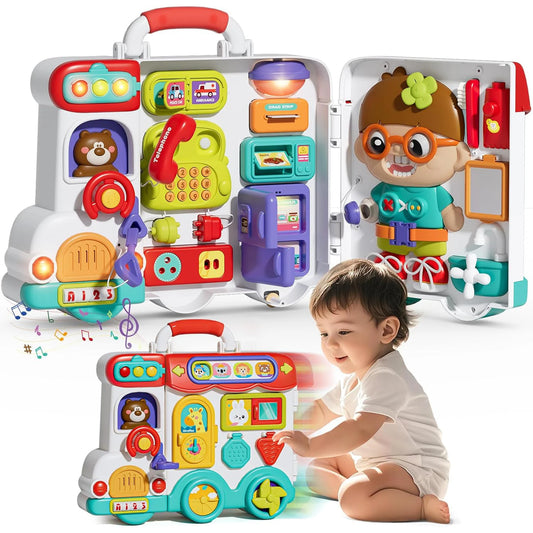
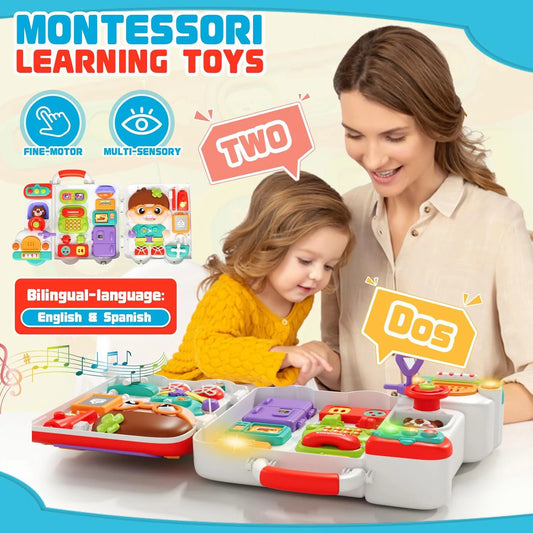
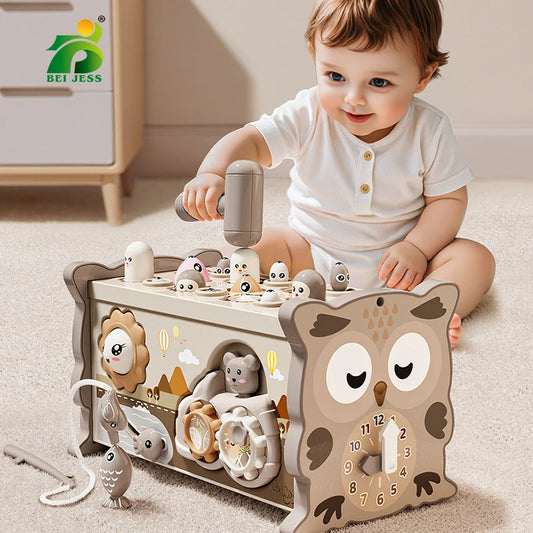
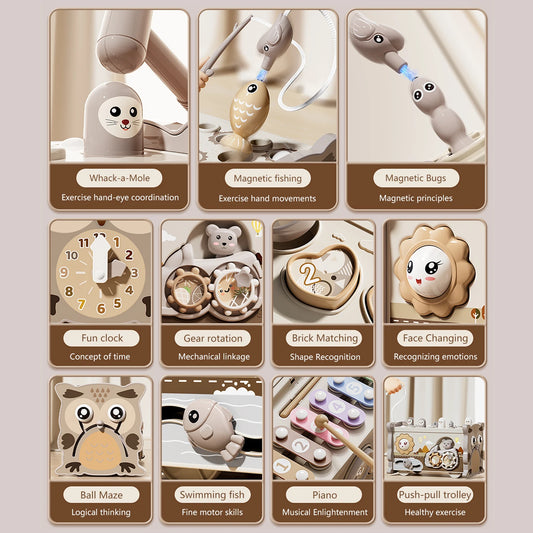

The best busy board for toddlers is not necessarily the one with the most activities, the highest price or the biggest “Montessori” label. A better choice is one that matches your child’s exact age and current abilities, has secure construction, provides activities at an achievable difficulty level and suits where you actually plan to use it. For children aged one to three, manufacturer age guidance and safety information should come before activity count or appearance.
| Busy board format | Best suited to | Main advantages | What to check carefully |
|---|---|---|---|
| Felt busy book | Travel, car trips and lighter play | Lightweight, foldable, easy to pack | Stitched attachments, removable pieces, cords, age rating |
| Wooden busy board | Regular home play | Stable surface, tactile hardware, durable construction | Fasteners, edges, loose hardware, board weight |
| Busy board cube | Floor or playroom use | Activities on several sides, compact footprint | Stability, small components, carrying weight |
| Montessori-inspired board | Families wanting practical-life activities | Often focuses on buckles, laces, switches and fastening | Whether activities actually suit the child's ability |
| Electronic or LED board | Older toddlers when appropriately age-rated | Switches, lights and cause-and-effect play | Battery type, battery compartment, warnings and sound level |
What Is the Best Busy Board for Toddlers?
The best toddler busy board is a board formally suitable for the child's age, with secure components and activities that are challenging without being frustrating. A one-year-old and a three-year-old should not automatically be given the same board simply because both fall within the broad “toddler” category. For broader ideas beyond busy boards, see Best Educational Toys for Toddlers: Development Guide for Ages 1-3.
Australian requirements are particularly relevant for younger toddlers. The mandatory standard for toys intended for children up to and including 36 months addresses risks from small parts that can release during normal play or reasonable wear. Battery-operated toys in this age group also have specific battery-compartment requirements.
Quick Selection Checklist
Before buying, check:
- Manufacturer's exact recommended age
- Under-three warnings and other safety warnings
- Whether the activities suit your child's current abilities
- How buttons, buckles, switches and other components are attached
- Whether magnets are present and how they are secured
- Whether the product contains batteries and what type
- Cord, ribbon, lace and loop length and accessibility
- Exact dimensions when available
- Product weight, especially for travel
- Cleaning or washing instructions
- Current Australian availability
- Returns and defective-product support
- Current product recalls before use

Choose by Exact Toddler Age
Age ranges matter because physical coordination, problem-solving ability and mouthing behaviour can change substantially between the beginning and end of the toddler years. A useful toddler activity board should provide some easy wins alongside activities requiring practice rather than presenting dozens of tasks the child cannot yet operate.
Manufacturer guidance should still be the starting point. Do not move a product intended for older children into a younger age group simply because its activities appear easy. Australian toy requirements may apply to products recognised as suitable for children under 36 months even when marketing or labelling suggests an older audience.
Best Board Features Around One Year
For a child around one year old, simplicity generally matters more than the number of activities. Look for large, securely attached components that can be pushed, turned, opened or moved without requiring precise finger sequences. A board containing a few clearly separated activities is often easier to understand than a crowded surface covered with fasteners.
This age also requires especially careful attention to small components and anything that could loosen. If you are shopping specifically for this younger stage, compare the board against Choosing the Best Toys for 1 Year Old Toddlers and Busy Board for Infants rather than relying on a generic toddler label.
Best Board Features Around Two Years
At around two, activities can become more sequential. Large zips, simple buckles, sliding mechanisms, flaps, matching activities and easy switches may provide a useful progression when the manufacturer includes the child's age. The objective is not to find the hardest possible board but to choose activities the child can begin independently and improve through repetition.
A two-year-old may also be more interested in practical-life actions seen during everyday routines. For additional age-specific comparisons, Best Toys for 2 Year Old Toddlers can help place busy boards alongside other suitable toy categories.
Best Board Features Around Three Years
Around three, more complicated dressing fasteners, lacing, matching, numbers, shapes and multi-step activities can become relevant. This is also the point at which more products marketed as busy books or Montessori activity boards begin to fall within their stated manufacturer age ranges.
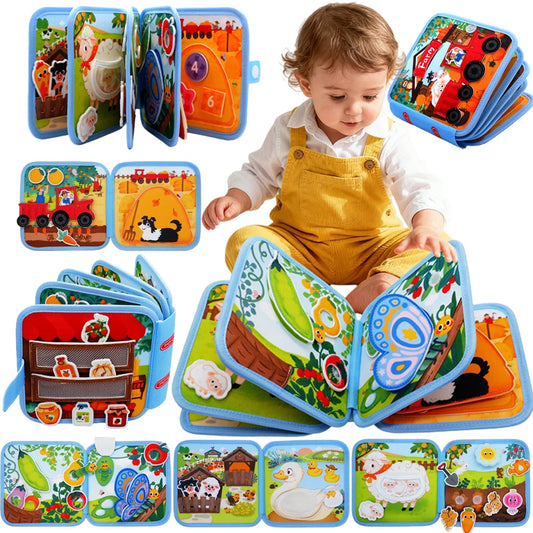
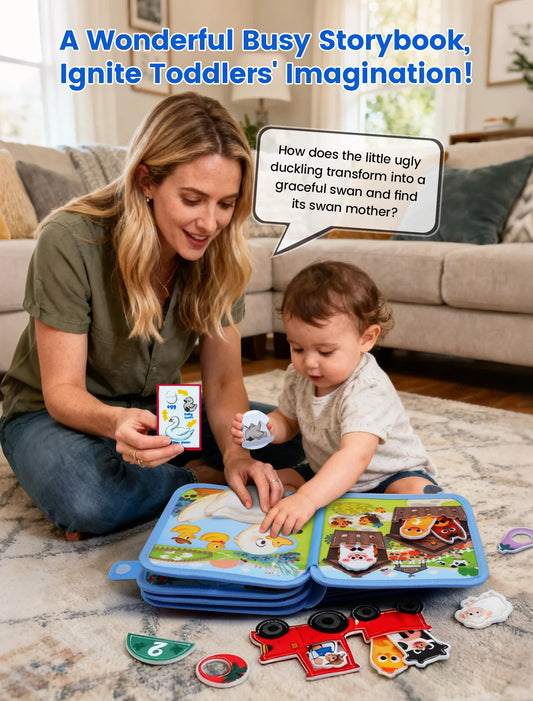
The current Toys4us Busy Board Toys For Toddlers Busy Book, for example, lists a recommended age of 3–6 years and includes zips, shoelaces, buttons, belt buckles, alphabet, weather, animal, colour, number and shape activities. Based on that published age range, it can be considered for a three-year-old but should not be automatically extended to one- or two-year-olds. For broader options at this stage, see The Best Toys for 3 Year Old Children.
What to Look For Before Buying
A reliable comparison should use the same criteria for every product. Activity count alone tells you very little: one board may advertise dozens of pieces but provide limited information about dimensions, construction or age suitability, while another may have fewer but better-documented activities.
A practical scoring method can prioritise age evidence first, followed by construction, activity suitability, safety information, dimensions and weight, cleaning guidance and after-sales support. A board that performs poorly on age or safety evidence should not compensate simply by having more features.
-
Manufacturer Age and Warnings
Start with the manufacturer's recommended age rather than the age used in the product title, advertisement or search result. “Toddler”, “baby” and “Montessori” are broad marketing descriptions and do not replace an actual age range.
Check packaging and product documentation again when the item arrives. For children up to and including 36 months, Australia's mandatory toy standard addresses design, construction and testing relating to small parts.
-
Useful Activities and Difficulty
Compare the type of interaction rather than counting every printed shape or detachable card as another “activity”. Turning a knob, opening a buckle, using a zip and matching shapes create different levels of physical and cognitive demand.
The best balance is usually a combination of activities the child can already perform and a smaller number they are beginning to learn. Too little challenge can reduce interest, while excessive complexity can turn the board into something the adult operates for the child.
-
Construction, Materials and Fasteners
For a wooden busy board for toddlers, inspect edges, screws, hinges, switches and other hardware. Nothing should become loose through ordinary handling. For felt designs, examine stitching around buckles, straps, removable pieces and handles rather than assuming that a soft material automatically makes the entire product appropriate for younger children.
Australian guidance also recommends checking that toys are sturdy and paying attention to cords and strings because unsuitable cords can present strangulation risks. Construction quality therefore matters more than whether the base material is wood, felt or plastic.
-
Dimensions, Weight and Storage
Dimensions determine whether a board fits on a toddler's lap, in a toy shelf or inside your travel bag. Weight affects how comfortably it can be carried and whether a rigid board is practical outside the home.
Do not accept “portable” or “lightweight” as substitutes for measurements. If a retailer does not publish exact dimensions or weight, ask before buying when portability is a major reason for choosing the product.
-
Cleaning, Returns and Support
Busy boards are repeatedly touched, carried and sometimes used around food, so cleaning instructions matter. Check whether felt components can be washed, whether wooden surfaces should only be wiped and whether electronic sections must remain dry. Follow the manufacturer's method rather than choosing a cleaning process based only on the material.
Return policies should also be reviewed before opening a product. Toys4us currently states that eligible standard returns must generally be initiated within 14 days of purchase and remain unopened and unused, while damaged or defective items are handled separately and may qualify for replacement or refund.
Related Products
Busy Board Formats Compared
There is no single format that is automatically better for every toddler. The decision is mainly a trade-off between portability, stability, activity style, storage and the manufacturer's age guidance.
Parents comparing a Busy Board should therefore decide on the intended setting first and then compare suitable products inside that category.
Felt Busy Books
A felt busy board for toddlers is usually the easiest format to carry. Book-style designs can fold closed and may combine dressing activities with matching, shapes, colours and simple puzzles. They are particularly practical when a rigid board would take up too much room.
The trade-off is that stitching and removable components need inspection. Check every attached item regularly and stop using the toy if stitching opens or a formerly secure component becomes loose.
Wooden Busy Boards
Wooden boards provide a firm platform for mechanical activities such as switches, wheels, locks, latches and doors. They can work particularly well when the board will remain in a play area rather than being packed into luggage.

Wood alone, however, is not evidence of Montessori quality or superior safety. Inspect finishes, edges, fasteners and hardware and confirm the product is intended for the child's age.
Activity Cubes
A busy board cube places activities on multiple surfaces rather than one flat panel. This can provide variety while using relatively little floor space, making cubes useful in playrooms or shared activity areas.
Consider stability as well as activity choice. A cube should remain manageable as the child pulls, turns and presses its components, and its total weight matters if adults expect to move it frequently.
Montessori-Inspired Boards
A Montessori busy board for toddlers usually emphasises hands-on activities resembling everyday actions, such as fastening, opening, closing, turning or matching. This may suit families interested in practical-life-style play, but “Montessori” should be treated as a description rather than proof that a product is better.
Compare the actual activities, age documentation and construction. Best Montessori Busy Board: What Parents Should Look For provides a more specialised framework if Montessori design is your main priority.
Electronic and LED Boards
An electronic busy board for toddlers may use switches and lights to create clear cause-and-effect responses. These designs can be engaging for children who enjoy operating switches, but they introduce additional questions about batteries, compartments and electronics.
Australian rules require products containing button or coin batteries to have secure battery compartments and meet relevant testing requirements. For toys intended for children up to 36 months, battery compartments must be secured so they can only be accessed using a tool. If you do not need electronic features, a non-battery board removes that particular consideration.
Which Activities Offer the Best Fit?
The most useful activities depend on what your toddler can currently do. Early boards may focus on pressing, turning and moving large components. Later boards can introduce zips, large buckles, laces, matching, basic dressing tasks, shapes, colours and simple sequencing.
Avoid judging a board by a headline such as “20 activities” or “50-in-1”. A smaller selection of clearly separated, appropriately challenging activities can be easier for a toddler to use independently than an overloaded design. Activity quality, attachment and developmental fit are more informative comparison criteria than the largest number printed on the packaging.
Look For
- Activities the child can already attempt
- A smaller number of activities requiring practice
- Clear separation between different tasks
- Large and securely attached components
- Activities with an understandable purpose
- Mechanisms that can be repeated independently
Do Not Judge by
- The largest advertised activity count
- “Toddler” or “Montessori” wording alone
- Decorative pieces presented as separate activities
- Activities that the adult must operate
- Appearance without age or construction evidence
- Difficulty far beyond the child's current abilities
Safety Checks for Toddler Busy Boards
For children under three, small parts deserve particular attention because Australia's mandatory standard is specifically intended to reduce risks from parts that detach during play or reasonable wear. Before first use and periodically afterwards, inspect fasteners, stitched components, zips, knobs and decorations for movement or damage.
Magnets and batteries require additional care. Australian rules set requirements for magnetic toys, including measures designed to prevent access to hazardous small magnets, and loose small high-powered magnets used in certain toys are permanently banned. Button batteries can cause severe injury if swallowed, so a battery-powered board should only be considered when its age guidance, battery enclosure and warnings are clear. Checking Australia's product-recall database before using an unfamiliar toy adds another useful verification step.
- Small Parts Check whether components can detach during normal play or after wear.
- Fasteners Inspect screws, hinges, knobs, buckles, switches and stitched attachments.
- Magnets Confirm that magnetic components remain securely enclosed and inaccessible.
- Batteries Check the battery type, warnings and security of the compartment.
- Cords and Loops Review the length and accessibility of ribbons, laces, cords and loops.
- Age Evidence Use the manufacturer's exact age range instead of broad marketing terms.
- Wear and Damage Recheck every frequently operated component before continued use.
- Product Recalls Check the Australian product-recall database before using an unfamiliar toy.
Home, Travel or Both?
For home use, size and weight may matter less than stability and activity variety. A larger wooden board or busy board cube can make sense if it has a permanent storage location. Families primarily buying for travel should put more emphasis on folded size, actual weight, loose components and whether the board can be quickly packed away.

A felt busy book often has an advantage for travel, but portability should never override age suitability. See Travel Busy Board for Toddlers: How to Choose the Right One if use in flights, cars or holidays is the main reason for buying. The Toys4us busy book is described as compact and travel-oriented, but its current product documentation lists the age range as 3–6 years and does not publish exact dimensions or weight on the product page checked, so those details should be confirmed rather than assumed.
Frequently Asked Questions
What Age Is Best for a Busy Board?
There is no universal best age. Busy boards are available for different developmental stages, but the correct starting point is always the manufacturer's stated age range. For children below three, pay especially close attention to small parts, attachments and age warnings.
A board intended for a three-year-old should not automatically be given to a one-year-old simply because both children are technically toddlers.
Is Felt or Wood Better for Toddlers?
Neither material is automatically better. Felt is generally more convenient when portability and compact storage are priorities, while wood provides a rigid base for switches, latches and mechanical activities.
Compare construction and age suitability rather than material alone. A well-constructed age-appropriate felt product may be a better choice than an unsuitable wooden board, and vice versa.
How Many Activities Should a Board Have?
There is no ideal activity count. More activities can provide variety, but only when the child can understand and operate a meaningful proportion of them.
A board with ten suitable activities may offer a better fit than one advertising fifty features that are repetitive, too difficult or poorly organised.
Are Montessori Busy Boards Better?
Not automatically. Montessori-inspired boards can be useful when they provide simple hands-on tasks, practical-life activities and opportunities for repeated independent practice.
The label itself does not establish safety, quality or age suitability. Compare manufacturer guidance and construction just as carefully as you would with any other toy.
Are Electronic Busy Boards Safe?
They can be appropriate when designed and formally age-rated for the child, but battery access must be considered. Products containing button or coin batteries supplied in Australia are subject to mandatory requirements relating to battery security and safety information.
Check the battery type, compartment design and warnings rather than assuming that an LED board is appropriate because the switches look simple.
Can One Board Suit Ages One to Three?
Sometimes, but only when the manufacturer's documented age range genuinely covers those ages and the activities remain useful as abilities develop. Many products marketed broadly to “toddlers” do not actually cover the full one-to-three range.
This distinction matters when shopping current ranges. The Toys4us busy book reviewed for this guide is specifically listed for ages 3–6, so it may provide an option from age three but is not a documented choice for ages one or two. When no current product clearly supports your child's age, choosing another age-appropriate toy is better than forcing a busy-board purchase.