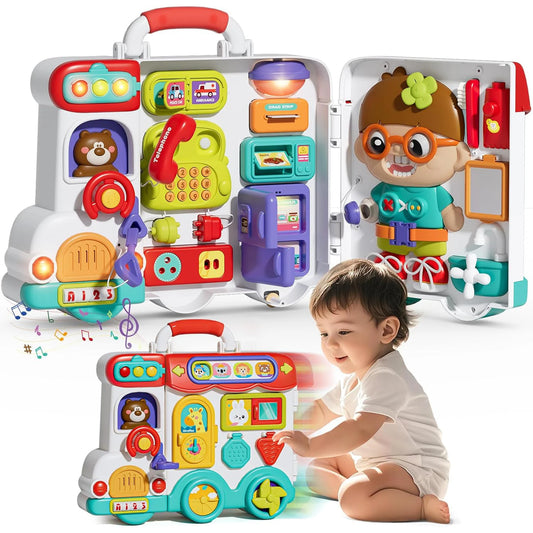
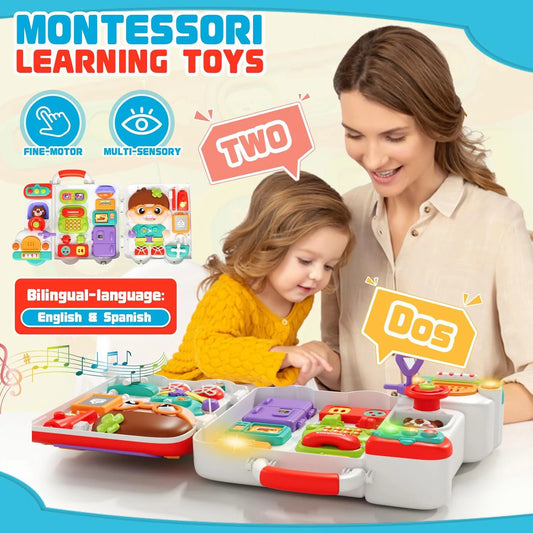
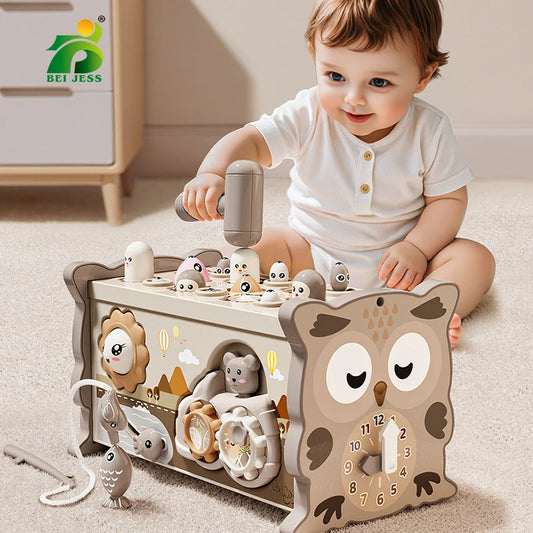
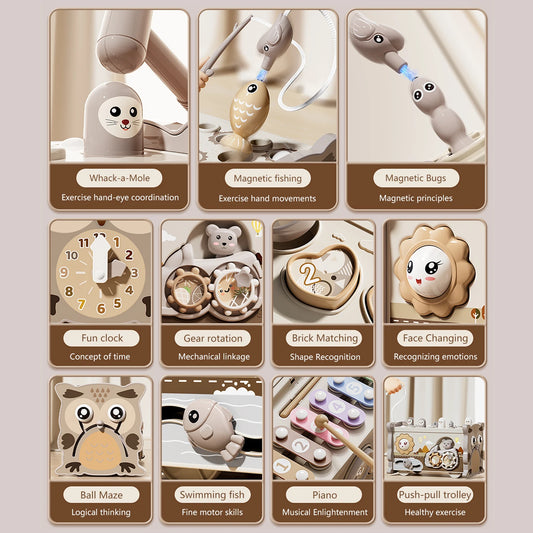

The best Montessori busy board is not necessarily the one with the most activities, the most natural-looking wood or the word “Montessori” printed most prominently on the packaging. A stronger choice has a manageable set of purposeful activities, suits the child’s actual age and current abilities, and provides opportunities to repeat useful movements without unnecessary distraction. Safety information, construction quality and manufacturer age guidance should always be assessed separately from Montessori-style marketing.
| Busy board type | Montessori alignment | Best suited to | Main consideration |
|---|---|---|---|
| Simple wooden latch board | High potential | Focused practice with doors, locks, sliders and latches | Weight, edges, metal fittings and exact age |
| Felt practical-life book | Moderate to high potential | Zips, buckles, buttons and portable practice | Loose pieces, crowded pages and fabric durability |
| Activity cube | Moderate to low potential | Children who enjoy several physical mechanisms | Often combines many unrelated activities |
| LED or electronic board | Low to moderate potential | Cause-and-effect play when appropriately designed | Lights, batteries and electronic stimulation may reduce focus |
| DIY board | Depends entirely on design | Parents wanting to select individual activities | Adult installation and construction become part of the safety assessment |
Parents wanting a broader comparison of formats can also start with Busy Board or Best Busy Board for Toddlers: How to Choose the Right One. This guide takes a narrower approach: it looks specifically at how well a board reflects Montessori-related principles rather than assuming every product carrying the label is equally suitable.
What Makes a Busy Board Montessori-Aligned?
Montessori alignment is better viewed as a spectrum than a yes-or-no category. A busy board can borrow useful ideas from Montessori education without being a traditional Montessori classroom material. Important characteristics include simplicity, purposeful movement, an appropriate level of challenge and activities that allow the child to concentrate on a recognisable task.
This distinction matters when reading product descriptions. Understanding What is Montessori Toy? and the differences discussed in Montessori Toys vs Conventional Toys can help parents look beyond colour palettes and marketing language.
Isolated Skills and Simplicity
One recognised Montessori concept is the isolation of difficulty: troublesome movements or procedures are separated so a child can focus on them without simultaneously managing several new challenges. AMI describes activities as being neither so difficult that they overwhelm the child nor so simple that they become boring.
Applied to busy boards, this does not mean a board must contain only one mechanism. It does mean that a crowded “50-in-1” board is not automatically better. If the child is learning how to operate a buckle, surrounding it with unfamiliar locks, numbers, removable shapes, laces and flashing switches may make focused repetition harder.
Practical, Reality-Based Activities
Practical-life activities are one of the stronger reasons busy boards can overlap with Montessori ideas. Zipping, fastening, opening, closing, sliding and buckling resemble movements children encounter while dressing or interacting with everyday objects. Montessori practical-life work commonly separates individual skills before combining them in more complex real-life tasks.
That does not mean a zipper board will make a child independently dress themselves. A better claim is that the activity provides a repeatable opportunity to explore a relevant hand movement. Look for mechanisms that operate realistically rather than decorative pieces that exist mainly to increase the advertised activity count.
Control of Error and Independence
“Control of error” refers to ways in which a child can notice and potentially correct a mistake without always needing an adult to announce that something is wrong. AMI gives examples of Montessori materials where the design itself helps reveal whether pieces have been placed correctly.
Some busy board activities have a simple version of this quality. A latch either reaches its catch or it does not; a buckle connects correctly or remains open. Other activities have no meaningful self-checking mechanism. Parents should therefore assess individual activities rather than assuming that every Montessori-labelled board is automatically self-correcting.
Why “Montessori” Is Not Certification
The word “Montessori” on a retail listing should not be treated as evidence that a product is appropriate for a particular age, complies with Australian safety requirements or follows every principle used in Montessori education. It is also not a substitute for reviewing materials, construction, warnings and individual activities.
This is especially important when a product looks “Montessori” because it uses wood, neutral colours or simple graphics. Natural-looking materials may suit a particular aesthetic, but appearance alone says little about activity design or safety. Educational alignment and product safety require separate checks.
What Is the Best Montessori Busy Board for Your Child?
The best Montessori busy board for toddlers is the one that offers a suitable challenge now rather than the product that promises the longest list of future skills. Start with age guidance, then compare the child’s existing interests and abilities with the mechanisms on the board.
For a broader framework covering different Montessori-style products, see Choosing the Best Montessori Toys for Your Child's Development. Busy boards should be assessed using the same principle: fit the material to the child rather than choosing according to marketing quantity.

Choose by Exact Age
Always begin with the manufacturer’s stated age range and warnings. Do not decide that a board is appropriate for a two-year-old merely because photographs show toddlers using it or because a product description uses general terms such as “baby”, “toddler” or “preschool”.
This is particularly important around age three. Australia has a mandatory safety standard covering toys intended for children up to and including 36 months, including requirements relating to small parts and battery-operated toys. A board labelled only for ages three to six should not simply be treated as an under-three toy.
Choose by Current Ability and Interest
Age alone cannot tell you which activity will hold a particular child’s attention. Observe what they already try to do. A child repeatedly interested in opening containers may engage with doors and simple latches, while another who tries to manage their own clothing may prefer zips, buckles or large buttons.
The goal is not to race towards harder mechanisms. A useful board provides enough challenge to encourage experimentation while still allowing repeated attempts. Activities that are far beyond the child’s current hand control can become frustrating rather than purposeful.
Prefer Useful Activities Over Quantity
Large activity counts often look impressive on product listings, but “25-in-1” or “50-in-1” does not describe the quality of those activities. Ten related, durable and appropriately difficult mechanisms can provide more focused use than dozens of small decorative tasks.
Check whether the child can repeat each movement and whether the activity has an understandable purpose. Letters, numbers, matching pieces and decorative elements may have value in other contexts, but adding them to every page does not automatically improve a busy board.
Related Products
Montessori Busy Board Formats Compared
A wooden Montessori busy board, felt Montessori busy board and portable Montessori busy board can all be more or less Montessori-aligned depending on their design. Material should therefore be treated as one comparison factor rather than the deciding feature.
The broader principles in A Guide to Montessori Toys for Toddlers in Australia can also be applied when comparing these formats.
| Format | Montessori alignment potential | Activity focus | Age evidence | Portability | Cleaning | Key safety review |
|---|---|---|---|---|---|---|
| Wooden latch board | High | Usually focused | Exact product age essential | Low–moderate | Usually wipe-clean | Edges, metal parts, screws, weight |
| Felt practical-life book | Moderate–high | Good when pages isolate tasks | Exact product age essential | High | Varies by product | Detachable pieces, stitching, cords |
| Activity cube | Moderate | Often mixed | Exact product age essential | Low | Usually wipe-clean | Protrusions, loose parts, stability |
| LED/electronic board | Low–moderate | Cause-and-effect focused or highly stimulating | Exact product age essential | Moderate | Usually surface-clean only | Battery access, switches, wiring |
| DIY activity board | Variable | Can be highly focused | Depends on components and design | Variable | Depends on materials | Installation, screws, batteries, loose components |
Simple Wooden Latch Boards
A simple Montessori latch board can align well with the principle of focused practical movement when it contains a small number of doors, bolts, catches or sliders. Children can repeat the same physical actions without constantly moving between unrelated concepts.

Wood does not automatically make a board superior. Check its weight, corners, surface condition, screws and metal fittings. Heavy boards can also be inconvenient for travel or lap-based play, so portability should be assessed separately from educational design.
Felt Practical-Life Books
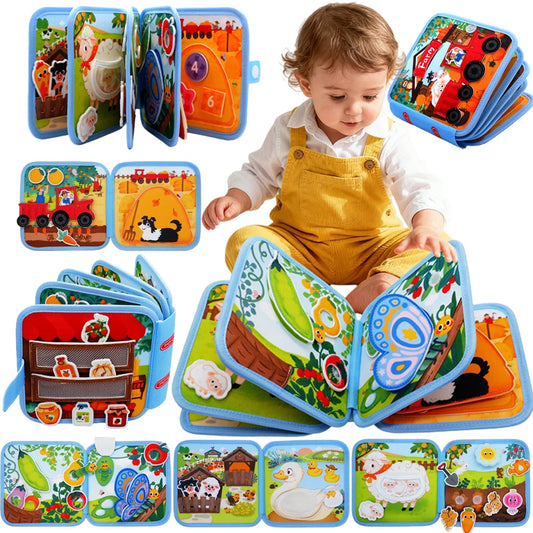
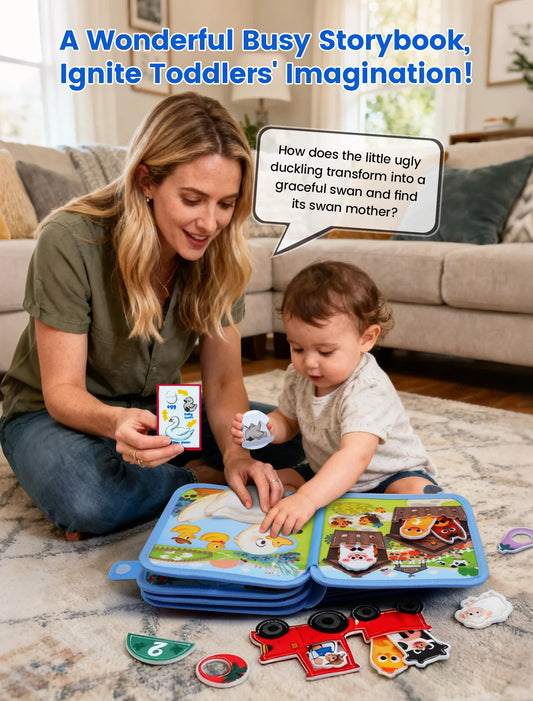
Felt books can work particularly well for fastening activities because zips, buckles, shoelaces and buttons naturally suit fabric. Their light weight also makes them one of the more practical formats for travel.

The main compromise is that many felt products become increasingly crowded as manufacturers add matching games, removable shapes, letters and numbers. Check stitching and detachable components carefully, particularly when pieces are attached with hook-and-loop fasteners or cords.
Activity Cubes
Activity cubes provide several surfaces and can contain locks, gears, shape activities, sliders or other mechanisms. Their physical construction may feel substantial, but the number of activities can also work against a Montessori-style preference for isolating the difficulty.
A cube can still be a reasonable choice if its sides are clearly organised and the activities suit the child. Inspect corners, rigid protrusions, removable pieces and overall stability before buying.
Electronic and LED Boards
An LED board can provide clear cause and effect: operate a switch and a light responds. That immediate feedback can make the mechanism understandable, but extensive lights and sounds may shift the experience away from a quiet, isolated practical activity.
Electronic design also introduces a separate safety issue. Products containing button or coin batteries supplied in Australia are subject to mandatory requirements, including secure battery compartments and compliance testing. Parents should check battery access independently of any Montessori claims.
Activities to Look For
A useful Montessori-style activity should have a clear purpose, appropriate difficulty and construction that permits repetition. A realistic latch that can be opened and closed many times may offer more meaningful engagement than several decorative pieces whose function is unclear.
Zips, Buckles and Buttons
Fasteners imitate movements used in clothing and bags, making them relevant to practical-life-style play. Large zips and straightforward buckles can provide an accessible starting point, while smaller buttons or more complicated closures demand greater finger control.
Assess the mechanism itself. A buckle that is too stiff or a button attached to flimsy fabric may technically add another “activity” without providing a satisfying task.
Doors, Latches and Object Permanence
Doors and latches combine a physical movement with a visible result. The child moves the mechanism, opens the door and can see what is behind it. Simple versions can therefore provide an understandable sequence without requiring extensive instructions.
Look for doors that move smoothly and fittings that remain firmly attached. Decorative hinges and metal components deserve the same construction checks as every other part of the board.
Wheels, Sliders and Cause-and-Effect
Wheels and sliders can be useful when the connection between movement and result is obvious. Turning, pushing and moving along a track encourage repeated hand actions and can form a relatively focused task.
Complexity should still be controlled. A board does not become more educational because every wheel activates a sound, number, colour and light simultaneously. Simple mechanical feedback is often easier for the child to interpret.
Letters, Numbers and Decorative Clutter
Letters and numbers are not automatically inappropriate, but they should not be included merely to increase activity counts or make a product appear educational. A board intended primarily for practical fastening practice can become visually and conceptually crowded when unrelated academic activities dominate the design.
Ask whether each addition supports the main purpose of the board. If removing an activity would make the remaining task clearer, the simpler design may be the better Montessori-aligned choice.
Safety and Age Verification
Always check the manufacturer’s exact age recommendation and warnings rather than relying on terms such as “toddler” or “Montessori”. In Australia, toys intended for children up to and including 36 months must meet specific safety requirements, including rules around accessible small parts and battery compartments.
Before use, check for loose pieces, magnets, cords, sharp edges, screws and insecure fasteners. Electronic boards should have secure battery compartments, and all boards should be inspected regularly for wear or damage. See Are Montessori toys safe for babies? for more age-specific guidance.
- Exact age range Confirm that the manufacturer includes the child’s current age.
- Small parts Check whether components can detach during use or after wear.
- Magnets Make sure magnetic components remain securely enclosed and inaccessible.
- Cords and fasteners Inspect laces, ribbons, elastic, buckles and attachment points.
- Edges and hardware Check corners, screws, hinges and metal fittings for damage or exposure.
- Battery compartment Confirm that batteries cannot become accessible to the child.
- Wear and damage Reinspect frequently pulled and moved components before play.
- Separate assessments Evaluate Montessori alignment and product safety independently.
How to Compare Current Toys4us Options
The current Toys4us range illustrates why products should be compared using evidence rather than Montessori wording alone. Busy Board Toys For Toddlers Busy Book currently lists a recommended age of 3–6 years and includes practical fasteners alongside alphabet, weather, animal, colour, number and shape activities. That makes it portable and varied, but also broader and less isolated than a simple fastening board.
Shoppers comparing the current range can browse Busy Board and Montessori Toys Australia, but there is not enough consistent evidence to name one product as the universal best Montessori busy board.
Products Labelled 3–6 Years
Several current listings use a 3–6-year age range. Toddler Busy Board – Montessori Toys, for example, currently states “Recommend Age: 3-6Y”, although the visible specification section provides limited detail about its activities. The LED busy board also lists ages 3–6 and describes a wooden board weighing approximately 300 g.
These age ranges make the products candidates for further comparison, not automatic recommendations. Activity quality, construction, battery design where relevant and the needs of the individual child still need to be checked.
DIY Accessories Versus Complete Boards
The current Montessori Busy Board Accessories listing is fundamentally different from a finished busy board. It contains DIY components, including electronic elements such as lamp- and doorbell-style activities, and lists a recommended age of 3–6 years. Toys4us itself states that these pieces must be installed securely by an adult and are not a ready-made board.
It should therefore not be ranked directly against complete products. Parents intentionally building a custom board may appreciate the ability to select individual mechanisms, but they also take responsibility for board design, placement and installation. For a broader DIY approach, see How to Make Montessori Toys.
Products With Conflicting Information
The current Toddlers Wooden Busy Board should be excluded from a recommendation ranking until its age information is clarified. Its specifications simultaneously state “Applicable age: Children (4-6 years old)” and “Recommend Age: 14+y”. Those two pieces of information cannot reasonably be treated as equivalent guidance.
A product with unclear age data should not receive extra credit simply because it is wooden or visually resembles Montessori materials. Reliable age information is a more important buying criterion than colour, material aesthetic or marketing terminology.
Frequently Asked Questions
Are Busy Boards Really Montessori?
Busy boards can be Montessori-aligned, but it is more accurate to evaluate their individual activities than to declare the whole product authentic or inauthentic. Focused practical movements, appropriate challenge and opportunities for independent repetition can overlap with Montessori principles.
A board containing many unrelated activities, flashing features and decorative learning tasks may sit further from those principles even when “Montessori” appears in its product name.
Are Wooden Boards More Montessori Than Felt Books?
Not automatically. A simple wooden latch board may isolate mechanisms very effectively, but a well-designed felt book containing one practical fastening task per page may do the same.
Material should therefore come after activity design. Wood can also introduce weight, hard edges and metal hardware, while felt products may contain detachable pieces or weak stitching. Each format has different strengths and safety checks.
How Many Activities Should a Montessori Board Have?
There is no ideal numerical target. The more useful question is whether the child can understand, repeat and concentrate on the activities provided.
A simple busy board with five or six well-chosen mechanisms may be more Montessori-aligned than a 30-activity board if it reduces distraction and provides an appropriate level of challenge. Quantity should never be used as a substitute for activity quality.