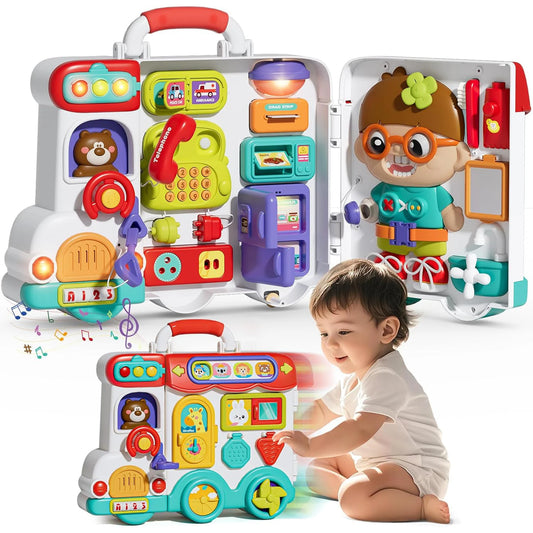
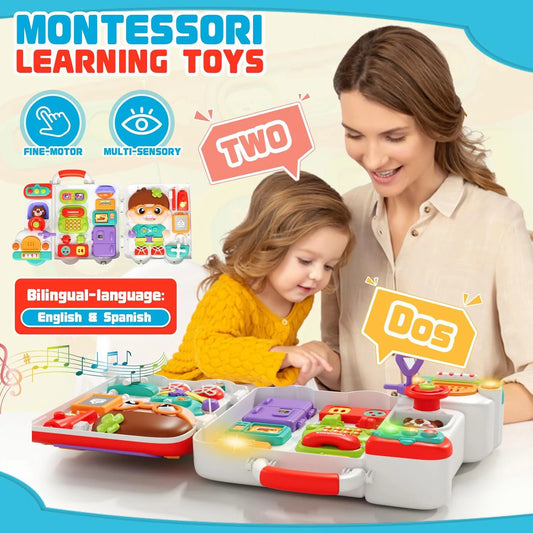
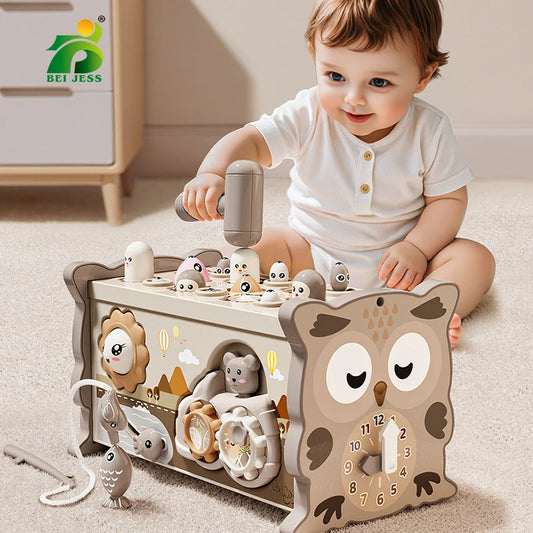
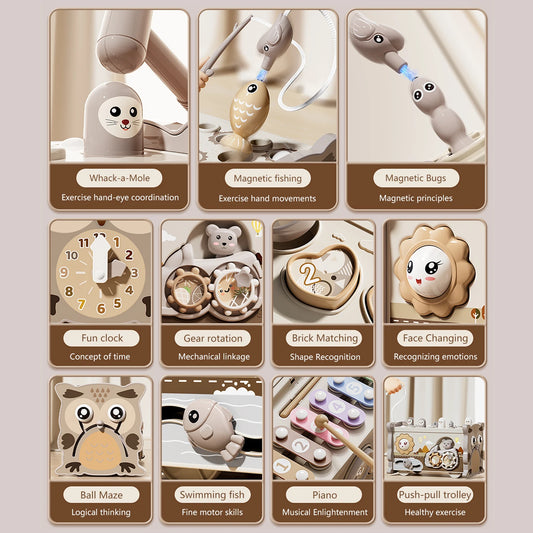

The best travel busy board for toddlers should match your child’s exact age, current abilities and the type of journey you are planning. A one-year-old, two-year-old and three-year-old may need very different activities, so manufacturer age guidance, secure construction, manageable size, easy cleaning and safe battery or magnet design should matter more than the number of activities advertised.
| What to compare | Good travel choice | Check carefully |
|---|---|---|
| Age suitability | Matches the manufacturer’s age range | Generic “toddler” labels |
| Size and weight | Easy to carry and use on a lap | Heavy or bulky designs |
| Activities | Secure and age-appropriate | Tiny or detachable pieces |
| Closure | Zip, buckle or secure fold | Loose pieces escaping |
| Noise | Quiet or adjustable | Constant electronic sounds |
| Cleaning | Wipeable or washable | Difficult-to-clean materials |
| Batteries | Clearly identified and secured | Accessible battery compartments |
| Journey fit | Suitable for the intended setting | Designs that restrict safe use |
What Is the Best Travel Busy Board for Toddlers?
The best option is one that passes a few practical checks: it is approved for your child’s age, has activities they can realistically use, is easy enough to carry and contains no poorly secured components. The right format also depends on the journey. A lightweight felt book may be ideal for a flight, while a compact wooden board could work better at a hotel or holiday destination.
Current busy-board ranges also show why checking individual products matters. Some products described as busy boards are designed for children aged three and above rather than the full toddler age range. Always check the specific listing instead of assuming every “toddler” or “Montessori” product is suitable from age one. For broader age-based guidance, see Best Educational Toys for Toddlers: Development Guide for Ages 1-3.
Quick Buying Checklist
- Confirm the manufacturer’s exact age range.
- Read all warnings and safety information.
- Check dimensions and weight.
- Make sure the board closes securely.
- Look for removable or potentially loose pieces.
- Check whether magnets are securely enclosed.
- Identify the battery type and compartment design.
- Inspect cords, ribbons and elastic.
- Consider noise levels for shared spaces.
- Read the cleaning instructions.
- Check the retailer’s return policy.
Related Products
Choose by Exact Toddler Age
“Toddler” covers a wide developmental range, so choosing by exact age is more useful than buying one product for ages one to three. Start with the manufacturer’s age guidance and then consider what your child can comfortably grasp, pull, turn, open and close.
The guides Choosing the Best Toys for 1 Year Old Toddlers, Best Toys for 2 Year Old Toddlers and The Best Toys for 3 Year Old Children can help narrow the choice further.
Around One Year
Around one year, simple activities are usually the most practical. Large flaps, easy sliders, wheels, simple switches and sturdy pieces give younger toddlers something they can explore repeatedly without requiring complex coordination.
Construction is especially important at this age because younger toddlers may pull, tug or mouth toys. Even a soft felt travel busy board should be checked for detachable shapes, buttons, ribbons and other components before purchase.
Around Two Years
Around two, toddlers may enjoy a wider range of activities such as zips, larger buckles, doors, wheels, sliders and simple matching tasks. Activities should offer some challenge without being so difficult that an adult must complete every step.
Lightweight felt books are particularly practical for this age during flights, restaurant visits and long waits. Check stitching, attachments and any loose components regularly, especially after the board has been folded and packed several times.
Around Three Years
By three, many children can manage activities involving several steps, including buckles, simple fasteners, matching games and basic letters or numbers. A slightly more complex board may therefore remain interesting for longer.
This is also an age where wooden boards, cubes and more detailed Montessori-inspired products become easier to compare. Still, follow the age stated on the individual product rather than moving to a 3+ design simply because your child is close to their third birthday.
What Makes a Busy Board Travel-Friendly?
A travel-friendly board needs to do more than have a carrying handle. It should fit inside your normal travel bag, remain comfortable to use on a lap or small table and close securely without losing pieces. Actual dimensions and weight are therefore more useful than marketing terms such as “portable”.
Think about where the toy will be used as well. Flexible felt books work well in restricted spaces, while rigid wooden boards require more room. Quiet activities and easy-clean surfaces are also useful when the same toy will move between cars, planes, restaurants and accommodation.

Travel Busy Board Formats Compared
There is no single best travel busy board for toddlers Australia families should choose. Felt, wood, cubes, Montessori-inspired designs and electronic boards each offer different advantages.
| Format | Main travel advantage | Main consideration |
|---|---|---|
| Felt busy book | Lightweight and compact | Loose pieces and stitching |
| Wooden board | Stable tactile activities | Extra weight and rigidity |
| Activity cube | Several activity surfaces | Bulkier to transport |
| Montessori-inspired board | Practical hands-on tasks | Age must still be verified |
| LED/electronic board | Clear cause-and-effect play | Batteries, noise and travel rules |
Felt Busy Books
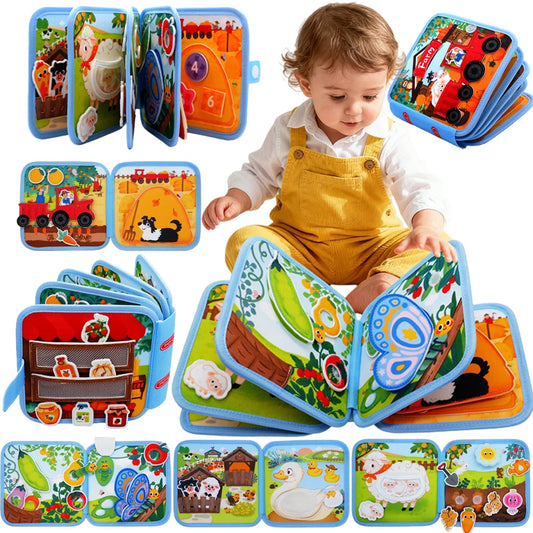
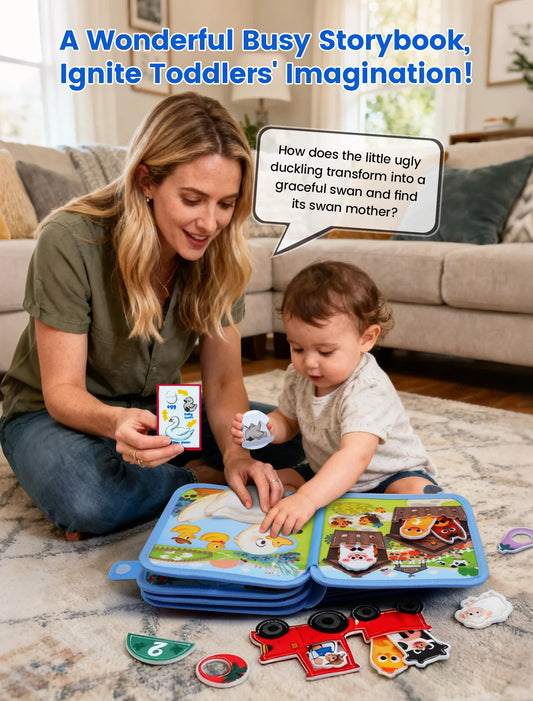
Felt busy books are among the easiest options to pack because they fold flat and usually weigh less than wooden designs. They can include zips, buckles, fabric fasteners and matching activities while remaining suitable for quiet environments.
Check whether pieces detach completely, whether stitching is secure and whether ribbons or elastic show signs of wear. A secure zip or storage pocket is also useful for keeping components together.
Wooden Boards
A wooden travel busy board provides a firm surface for switches, wheels, latches and other mechanical activities. Smaller wooden boards can work well for older toddlers who enjoy turning, opening and moving physical components.
Their main disadvantage is portability. Compare actual dimensions and weight, and regularly inspect edges, screws and hardware. A compact wooden board is usually much easier to travel with than a large activity centre.
Activity Cubes
Activity cubes use several sides for play, allowing a relatively small object to offer different activities. They can work particularly well in hotel rooms or holiday accommodation where children have a stable floor or table.
However, cubes are bulkier inside luggage and may be awkward on planes or small restaurant tables. Check their dimensions, corners, weight and any removable components before choosing one specifically for travel.
Montessori-Inspired Boards
A Montessori travel busy board often focuses on practical actions such as fastening, turning, matching and opening. These can encourage independent exploration, particularly when activities are simple enough for the child to attempt without constant help.
However, “Montessori” does not define an age range or guarantee safety. Check the same details you would for any other toy: age guidance, component security, size, activity difficulty and loose parts. See A Guide to Montessori Toys for Toddlers in Australia for more information.
Electronic and LED Boards
Electronic and LED boards use switches, buttons, lights and sometimes sound to create clear cause-and-effect play. They can be engaging for older toddlers, particularly during long waits or journeys.
They also need extra checks. Confirm the child’s age suitability, battery type, battery-compartment security and whether sounds can be disabled. For travel, you should also know exactly what type of batteries the product contains before taking it onto an aircraft.
Which Activities Suit Toddlers?
The number of activities matters less than whether your child can actually use them. A simple board with a few suitable features may provide more useful play than a crowded board filled with activities that are too difficult.

For more general information about how these toys work, see What Are Busy Boards? A Parent’s Guide to Types, Benefits and Uses and Busy Board.
Zips, Buckles and Buttons
Zips and larger buckles can be useful for older toddlers because they copy familiar dressing movements. Choose components that are easy to grasp and securely attached to the board.
Buttons require more careful checking because their size and attachment vary. Small decorative buttons or poorly secured components may not be appropriate for younger toddlers.
Latches, Wheels, Gears and Sliders
Mechanical activities provide immediate feedback: a wheel turns, a door opens or a slider moves. Simple versions may suit younger toddlers, while more complicated locks and latches generally become easier as coordination improves.
For travel, also look at how far these components project from the board. Heavy or protruding hardware can increase weight and make the toy less convenient for lap play.
Matching, Letters and Numbers
Matching colours, shapes and pictures can add variety for older toddlers. Letters and numbers may also become interesting as children approach three, particularly when presented as simple hands-on activities rather than formal lessons.
Check how matching pieces are attached. A board containing many completely removable shapes may be inconvenient during a flight or restaurant visit because pieces can easily fall or become lost.
Loose Pieces and Activities to Assess Carefully
Loose components deserve additional attention for younger toddlers. Before use, inspect the board for pieces that may separate from stitching, fasteners or other attachments, particularly after repeated travel.
Magnetic activities also require careful checking. Magnets should remain securely enclosed inside the toy rather than becoming accessible if the board is pulled, dropped or damaged.
Choosing a Board for the Journey
A board that works well at home may not be the best choice for every type of travel. Think about where your toddler will use it, how much space is available and how easily the toy can be packed away.
The goal is to provide convenient hands-on play during suitable parts of the journey. A busy board can help with entertainment, but it should not be expected to keep every toddler quiet for a predictable amount of time.
Plane Travel
For flights, prioritise a compact, lightweight and quiet airplane busy board for toddlers. Folding felt designs can be particularly convenient because they fit easily into hand luggage and are manageable on a lap or tray table.
Avoid products with many loose pieces that could fall beneath seats. For electronic boards, identify the battery type in advance and check current airline requirements before flying.
Car Travel
For car journeys, choose a lightweight toy that does not interfere with the child restraint, harness or normal seating position. The board should be easy to give to the child and remove when necessary.
Do not attach a busy board to a car-seat harness or other restraint components unless the relevant manufacturers specifically allow it. Safe restraint use should always take priority over entertainment accessories.
Trains, Restaurants and Waiting Rooms
These environments favour boards that open quickly, stay quiet and keep their activities contained. Felt books and small flat boards can be particularly convenient because they are easy to use on a lap or table.
A handle and secure closure are also valuable when moving between locations. If you choose an electronic model, look for one with adjustable or switchable sound.
Hotels and Holidays
At your destination, you may have more space to use larger boards. A small wooden board or activity cube that feels bulky during transport can become useful once your toddler has access to a stable table or floor.
Cleaning also becomes more important during longer trips. Check whether the product can be wiped clean, hand washed or cleaned using another manufacturer-approved method before travelling.
Safety and Product Verification
Safety checks should always happen at the individual product level. Confirm the manufacturer’s age recommendation, warnings, dimensions, included components and construction. For children under three, pay particular attention to small parts, magnets, cords and accessible batteries.
Inspect the travel busy board for toddlers again before each trip and after it has been dropped or compressed in luggage. Look for loose stitching, exposed components, damaged hardware, accessible magnets or changes to the battery compartment. Stop using a damaged product until you can confirm it remains safe.
If you are shopping for a younger child, Travel Busy Board for Baby: How to Choose Safely provide more specific guidance rather than treating all toddler products as interchangeable.
- Age guidance Confirm the manufacturer explicitly includes your child’s current age.
- Warnings Read all small-parts, battery, magnet and supervision information.
- Stitching and fasteners Check for loosening, fraying and components beginning to separate.
- Magnets Make sure magnetic components remain securely enclosed and inaccessible.
- Battery compartment Confirm it remains secure, undamaged and inaccessible to the child.
- Edges and hardware Look for cracks, rough areas, exposed screws and damaged fittings.
- After travel Reinspect the board after it has been dropped or compressed in luggage.
- Damage Stop use when a safety-related feature becomes loose, exposed or damaged.
Frequently Asked Questions
What Age Can a Toddler Use a Travel Busy Board?
There is no single starting age for all busy boards. Some are designed for younger toddlers, while others are recommended only from age three. Always check the age range stated by the manufacturer.
Is Felt or Wood Better for Travel?
Felt is generally lighter, softer and easier to pack, making it convenient for flights and day trips. Wood provides a firmer surface for mechanical activities but usually adds more weight and takes up more space.
Neither material is automatically better for every child. Age suitability, construction and the type of journey should guide the choice.
Can a Busy Board Be Used on a Plane?
Yes, a compact busy board can be a useful travel toy during suitable parts of a flight. Quiet activities, lightweight construction and securely contained pieces make the board easier to manage.
If the board uses batteries, check the battery type and your airline’s current requirements before travelling.
Can It Be Attached to a Car Seat?
Do not attach a busy board directly to a child restraint, harness or its components unless the restraint and toy manufacturers specifically permit it.
A lightweight board that the child can hold independently is generally more practical than modifying or adding attachments to the restraint.
Are LED and Magnetic Boards Suitable for Toddlers?
They can be, provided the individual product is designed for your child’s age and all batteries or magnets remain securely enclosed.
For younger toddlers, unclear battery information, accessible compartments or detachable magnetic pieces are good reasons to choose a simpler alternative.
Will a Busy Board Keep a Toddler Quiet?
A busy board can be one of several useful quiet travel toys for toddlers, but no toy can guarantee quiet behaviour or a specific attention span.
Choose activities your child can operate independently and introduce the board before the journey. A suitable travel busy board for toddlers should make travel play easier rather than create unrealistic expectations about how long a toddler will remain occupied.