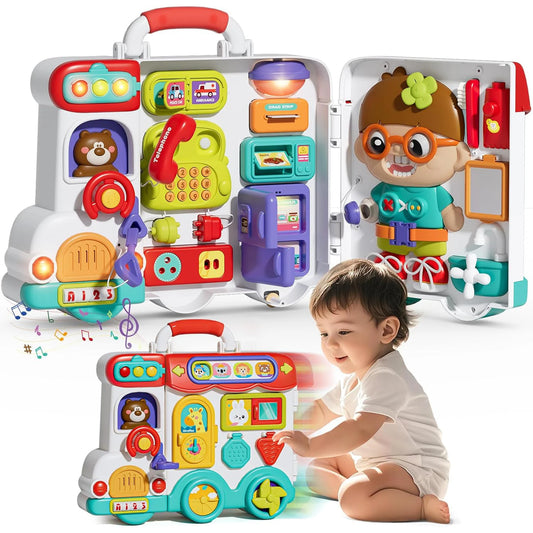
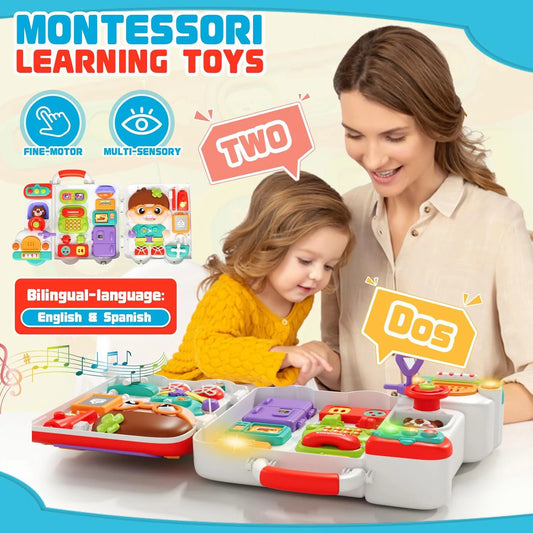
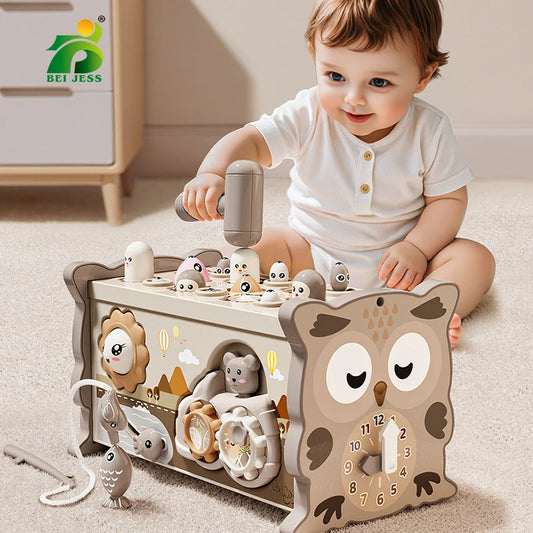
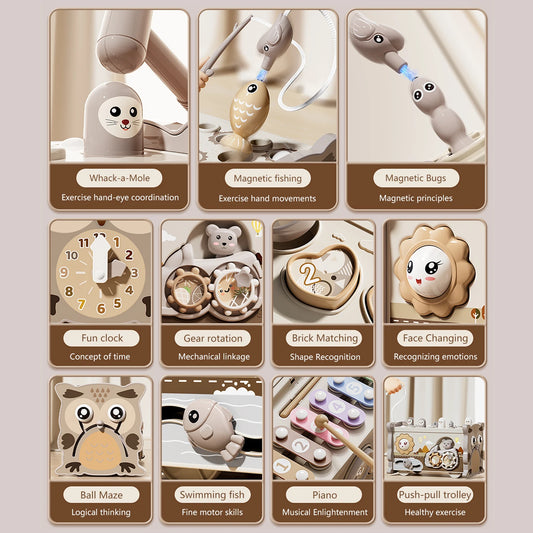
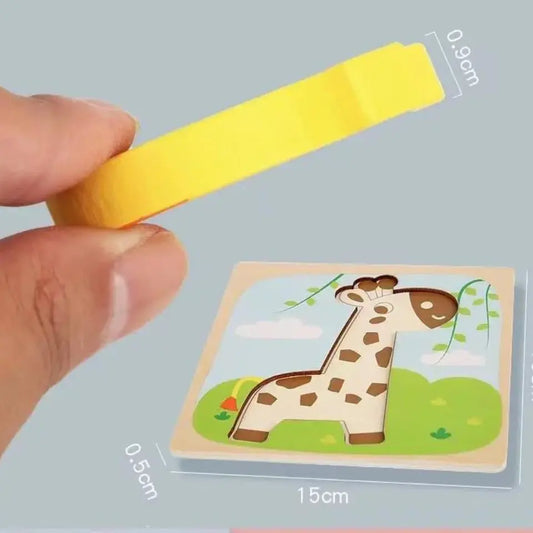
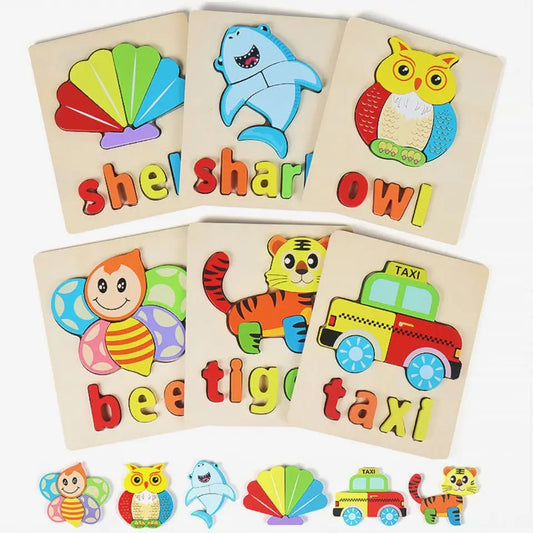
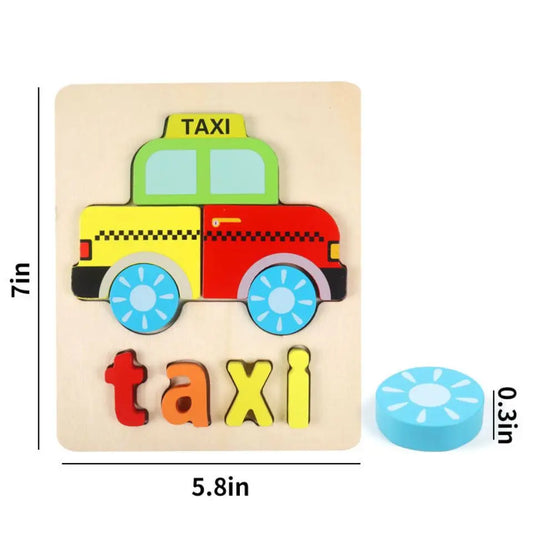

A travel busy board for baby may be suitable when the manufacturer clearly states that it is appropriate for your baby’s exact age and the design can withstand typical infant behaviour such as grabbing, pulling, shaking, dropping and mouthing. Terms such as “baby”, “sensory” or “Montessori” do not automatically mean a product is appropriate for a child under 12 months.
For younger babies, simple soft sensory products are often easier to consider than traditional toddler boards filled with locks, buckles, laces and removable pieces. Whatever the format, parents should check the age recommendation, construction, small parts, batteries, magnets and cords before use.
| What to Check | Better for Babies | Reasons to Avoid |
|---|---|---|
| Age information | Exact age range includes your baby | Only labelled “baby” or “Montessori” |
| Activities | Large, simple, firmly attached features | Small pieces, locks or loose accessories |
| Construction | Secure stitching and smooth surfaces | Loose threads, sharp edges or exposed hardware |
| Electronics | Secure battery compartment | Accessible batteries or unclear specifications |
| Travel design | Lightweight and easy to inspect | Heavy, bulky or difficult to clean |
| Sleep use | Supervised awake play only | Intended for cot or sleep-space use |
Can Babies Use Travel Busy Boards?
Some babies can use certain travel busy boards, but traditional busy boards are commonly designed for toddlers. Babies are more likely to mouth components, pull attachments, shake the board or repeatedly drop it, so the manufacturer’s minimum age should always be the first consideration. Australian toy-safety guidance also emphasises age-appropriate construction and the risks associated with small parts for babies and young children.
The word “baby” in a retailer listing is not enough. Collection names, sensory terminology and Montessori marketing cannot replace the age information, warnings and product instructions supplied for the individual toy. Parents shopping for younger infants may also compare simpler options in Best Toys for 6 Month Old Babies before choosing a busy board.
Choose by Exact Age, Not the Word Baby
Babies develop quickly during their first year, so one broad “baby” category is not very useful. A six-month-old may mainly grasp, mouth and pat a toy, while an older infant may begin intentionally pressing, turning or opening simple features. For younger babies, large textured areas, secure fabric sections and uncomplicated attached features are generally more appropriate formats to investigate.
Development should never be used to override the manufacturer’s age restriction. A nine-month-old who enjoys pressing buttons is still not automatically ready for a toy labelled 3+. Parents considering a board later in infancy can also read Travel Busy Board for a 9 Month Old: Can Babies Use One Safely? for more age-specific information.
Related Products
Travel Busy Board Formats Compared
A portable busy board for baby should be assessed as a complete product rather than judged only by its material. Soft boards are often lighter and more convenient for travel, but loose stitching or removable decorations can still create problems. Wooden and electronic products may be durable but usually require additional checks.
When comparing a baby sensory board for travel, focus first on age suitability and secure construction. The number of advertised activities matters far less than whether those activities are appropriate for an infant.
Soft Sensory Panels
Soft sensory panels may include textured fabrics, crinkle sections, large flaps and securely attached features. When specifically designed for a baby’s age, their light weight and flexible construction can make them convenient for planes, cafés and other travel situations.
Inspect seams, fabric tabs and decorations regularly. Stop using the product if stitching loosens, filling becomes exposed or attached pieces start separating.
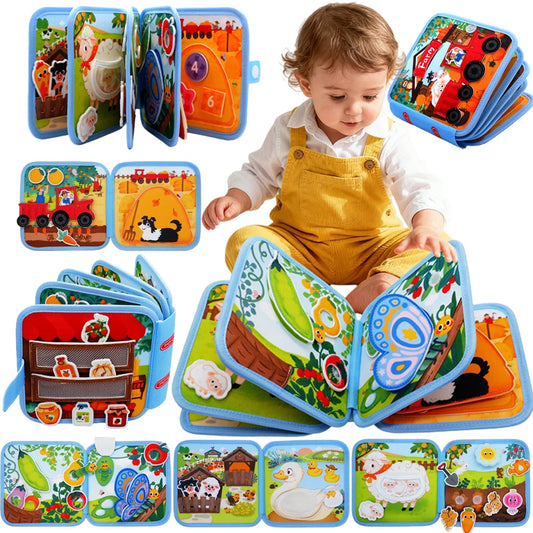
Felt Busy Books
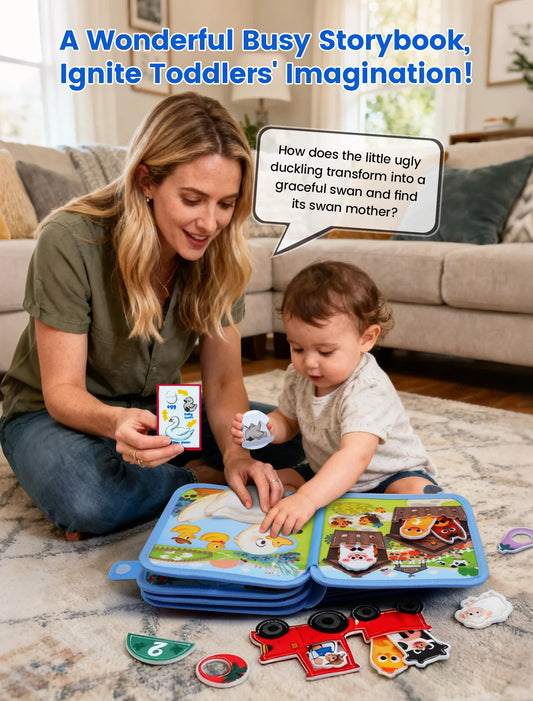
Felt books are popular among parents searching for travel toys for babies Australia because they fold flat and fit easily into a bag. However, many felt busy books are actually toddler products.
Check every page for removable shapes, buttons, buckles, laces or small matching pieces. A soft felt cover does not make these features automatically suitable for babies.
Wooden Boards and Cubes
Wooden boards and activity cubes often include sliders, switches, doors and turning mechanisms. Many are aimed at toddlers, so checking the manufacturer’s age recommendation is particularly important.
Also consider weight and hardware. Corners should be smooth, and screws, hinges, knobs and other fittings should remain secure during normal use.
Electronic and LED Boards
Electronic boards may include lights, sounds, switches and buttons, but batteries introduce another hazard to assess. Battery compartments on toys intended for young children should be securely designed so babies cannot access the batteries.
For air travel, check the battery type as well. Products containing lithium batteries may also need to comply with CASA and individual airline baggage requirements.
Baby-Specific Safety Checks
Safety checks should reflect how babies actually interact with toys. Assume that any accessible feature may be mouthed, pulled, shaken or dropped rather than handled gently. Australian safety requirements for toys intended for children up to and including 36 months specifically address hazards such as small parts that may become accessible during use or wear.

Inspect a new board before the first trip and check it again regularly. Even an initially secure toy can become unsuitable once stitching, attachments or fittings begin to deteriorate.
Mouthing, Pulling, Shaking and Dropping
Babies commonly explore toys with their mouths and may pull or throw them repeatedly. Look for sturdy construction that does not easily break apart when subjected to this type of use.
Check seams, attachments and moving features before travelling. Loose components can be more difficult to notice when you are also managing luggage or transport.
Small and Detachable Parts
Avoid products with small components that a baby could remove, break off or swallow. Toys designed for children under three are subject to specific Australian requirements concerning small parts.
Be cautious with decorative buttons, beads, detachable felt shapes, small accessories and removable puzzle pieces. Supervision should not be used as a substitute for choosing an appropriately constructed toy.
Magnets
Magnets can be extremely dangerous if swallowed, particularly when more than one magnet is involved. Australian safety standards include requirements for toys containing hazardous magnetic components.
For babies, a non-magnetic product may be the simpler choice. If you cannot confirm that the magnets are securely enclosed and appropriate for the stated age, avoid the product.
Batteries
Button and coin batteries can cause serious injury when swallowed. Electronic busy boards therefore require careful checking of both the battery type and compartment design.
Make sure the compartment cannot be opened by the baby and review the manufacturer’s age information and warnings. Do not rely only on product photos when checking battery security.
Cords, Laces and Loops
Long cords, ribbons, laces and elastic loops can create hazards for babies. These features are particularly common on dressing-style busy boards designed to teach older toddlers fastening skills.
For an infant, choose simpler activities instead. Cutting or modifying a toddler board does not make the entire product suitable for a baby.
Mirrors, Edges, Fibres and Coatings
Mirrors should be securely integrated into the product, while wooden or plastic surfaces should be smooth and free from sharp points or exposed hardware. Felt products should be checked for loose fibres, threads and exposed filling.
Also follow the manufacturer’s cleaning instructions, especially for toys frequently mouthed by babies. Claims such as “natural” or “non-toxic” are useful only alongside proper age grading and safe construction.
Choosing a Board for Different Journeys
A suitable travel toy should work safely in the environment where it will actually be used. Consider weight, loose pieces, supervision requirements and whether the product could interfere with other equipment such as a child restraint.
Try the board at home before travelling. This makes it easier to see which components your baby immediately pulls or mouths and whether the toy is practical to manage outside the home.
Plane Travel
For flights, lightweight boards with securely attached features are generally more practical than heavy boards or products containing many removable pieces. A product described as an aeroplane toy should not be assumed to have formal airline approval.
If the board contains lithium batteries, check current CASA guidance and your airline’s baggage rules before travelling.
Car Travel
A busy board must never interfere with the child restraint, harness or correct seating position. Avoid fastening toys to the restraint unless the restraint manufacturer specifically permits it.
Heavy boards and activity cubes may also be less practical in a vehicle. Choose lightweight products suitable for supervised use instead.
Prams and Public Places
A compact soft board can be useful during supervised awake time in a café, waiting room or other public setting. Check all straps and attachment points before connecting anything to a pram.
Reassess the setup as your baby grows. A toy or attachment that was practical for a younger infant may become unsuitable once the baby can pull up, push forward or reach more areas of the pram.
Hotels and Holiday Accommodation
Holiday accommodation can contain unfamiliar objects and surfaces. Inspect the play area before placing your baby down with any activity toy.
Using familiar toys from home is often easier than relying on shared toys at accommodation. A small washable sensory toy may also be more practical than a complicated activity board.
No Cot, Bassinet or Sleep-Space Use
A travel busy board is intended for supervised awake play and should not be left in a cot, portable cot, bassinet or another baby sleep space. This applies even to soft felt products.
Australian safe-sleep guidance recommends keeping toys and loose objects out of a baby’s sleep environment. Remove the busy board completely before your baby sleeps.
How to Compare Baby Travel Activity Products
Start with the product documentation. Look for a clear manufacturer age range, warnings, care information, battery details where relevant and enough information to understand how each activity is constructed. Conflicting or missing age recommendations are a reason to look for another product.

After safety and age suitability, compare weight, dimensions, cleaning requirements and whether pieces detach. A simple Montessori travel busy board for baby with a few age-appropriate features is generally a better candidate than a complex board containing dozens of toddler activities. Parents can also read Montessori Toys for Infants: Enhancing Learning from an Early Age and Are Montessori Toys Safe for Babies? for further guidance.
- Exact age range Confirm that the manufacturer explicitly includes your baby’s current age.
- Warnings Read small-parts, battery, magnet, cord and supervision information.
- Construction Check seams, attached features, hardware and accessible surfaces.
- Weight and dimensions Compare exact measurements with your bag and available play space.
- Cleaning Check whether the product can be cleaned and dried as required during travel.
- Detachable pieces Identify everything that comes off or could separate after wear.
- Battery information Confirm battery type and whether the compartment remains inaccessible.
- Travel use Check whether it can be supervised, stored and packed without affecting other equipment.
Understanding the Toys4us Busy Board for Infants Collection
The Toys4us Busy Board for Infants collection should be treated as a shopping category rather than confirmation that every listed product is suitable for every baby. The range contains different styles and age recommendations, including products intended for younger children alongside felt boards, magnetic activities, cubes and electronic or light-up formats aimed at older age groups.
Parents should therefore check each individual product page rather than relying on the collection name. If a product lists an older minimum age, contains small parts or includes features unsuitable for infants, its placement within an infant-related category does not override those details. For a broader explanation of how these products differ, see What Are Busy Boards? A Parent’s Guide to Types, Benefits and Uses.
A collection title is a way to organise products. It does not replace the age grading, warnings or safety information on each individual product page.
Alternatives When No Busy Board Is Suitable
There is no need to buy a busy board if you cannot find one clearly approved for your baby’s age. Depending on manufacturer guidance, simpler options may include soft cloth books, large grasping toys, baby-safe rattles, textured toys or other lightweight sensory products.

Travelling with two or three familiar toys can also be easier than carrying one complicated activity board. The aim is not to guarantee quiet travel, independent play or fewer tantrums, but simply to offer suitable supervised activities during awake periods.
Frequently Asked Questions
What Is a Busy Board for Babies?
A busy board is an activity toy containing features that children can touch, move or manipulate. Baby-focused versions may use textures, flaps and simple attached components, while toddler versions often include zips, locks, buckles and puzzles.
The term itself is not a safety classification, so parents still need to check the individual product’s recommended age.
Are Busy Boards Good for Babies?
An age-appropriate busy board can offer opportunities for supervised touching, grasping and manipulating, but it is not an essential developmental toy.
Suitability depends on the product’s age grading and construction rather than whether the baby appears interested in it.
What Is the Best Travel Busy Board for a Baby?
There is no single best travel busy board for baby. Look for a product specifically approved for your baby’s age, with secure components, simple activities and a lightweight format that is easy to supervise.
Soft sensory formats may be practical for younger babies, but the material alone does not establish safety.
Are Felt Busy Boards Safe for Babies?
Some felt boards may be appropriate when specifically designed and labelled for the baby’s age. Others contain detachable shapes, buttons, laces or buckles intended for toddlers.
Check the age recommendation, stitching and every attached component before use.
Can a Baby Use One on a Plane or in a Car?
An age-appropriate board can sometimes be used during supervised travel. In a car, it must not interfere with the child restraint or harness, while battery-operated products taken on flights may be subject to airline and aviation requirements.
A “travel toy” label does not automatically mean the product is approved for every transport situation.
Can a Travel Busy Board Be Used in a Cot?
No. Busy boards should be used during supervised awake play and removed completely before sleep.
Keeping toys and other loose objects out of a baby’s sleep space is consistent with Australian safe-sleep recommendations.
What Should Parents Choose Instead?
If no busy board has clear age documentation and suitable construction, choose a simpler toy specifically designed for your baby’s age. Cloth books, grasping toys, rattles and basic sensory toys may be easier alternatives to assess.
For baby travel, age suitability, secure construction and easy supervision are more important than how many activities a toy contains.