
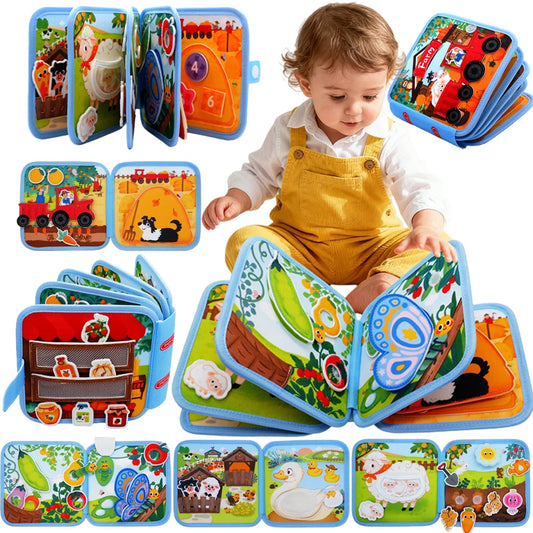
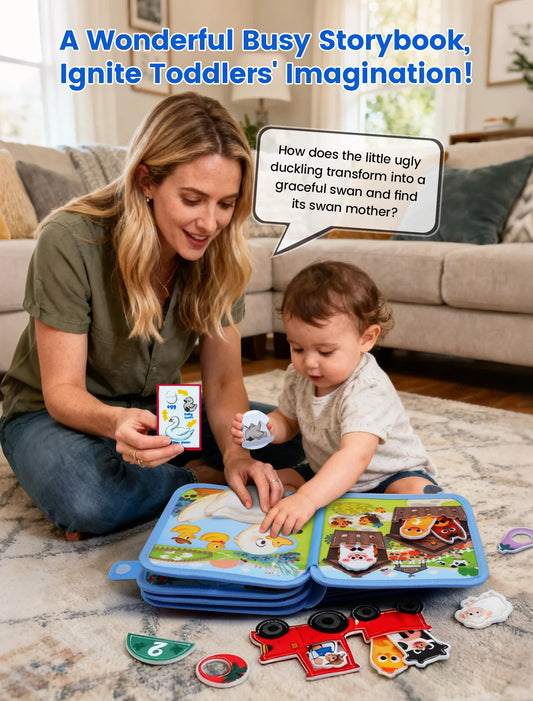
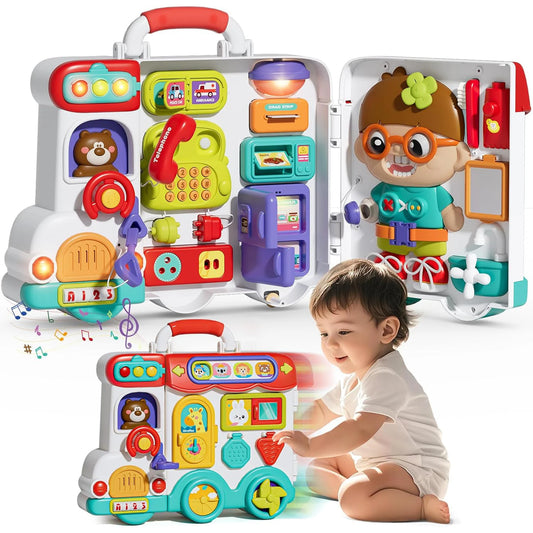
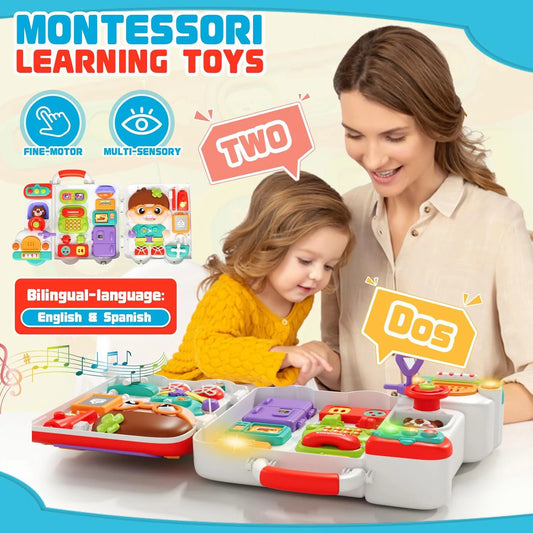
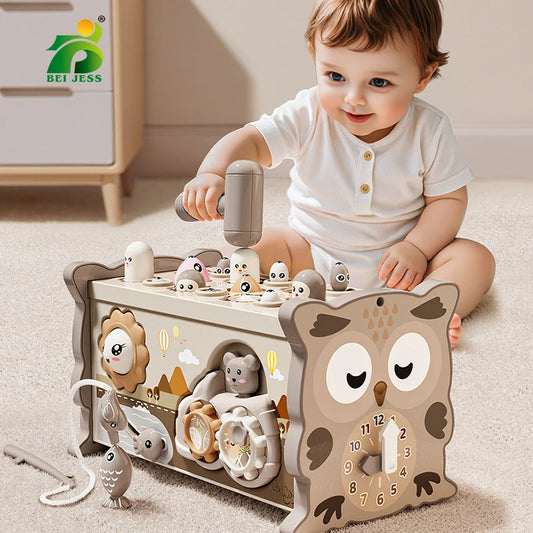
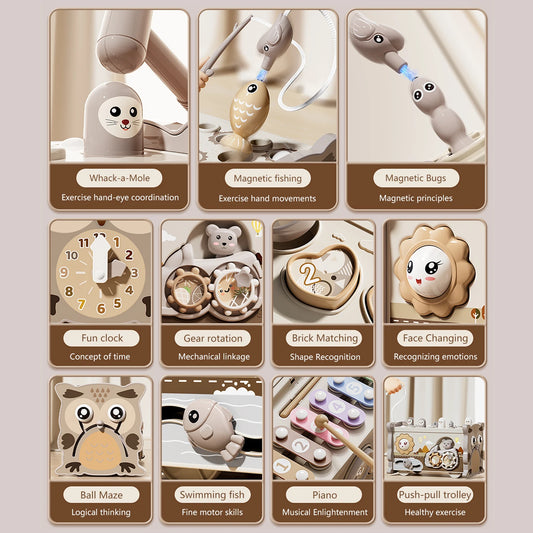
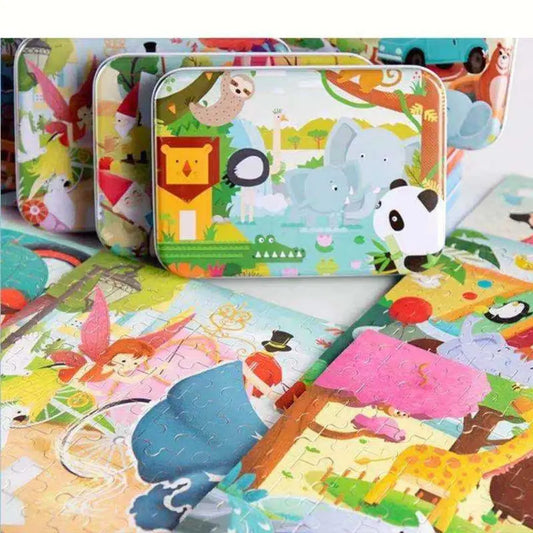
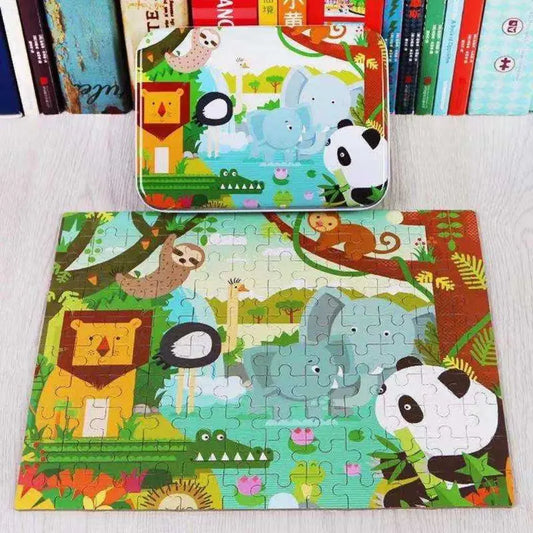
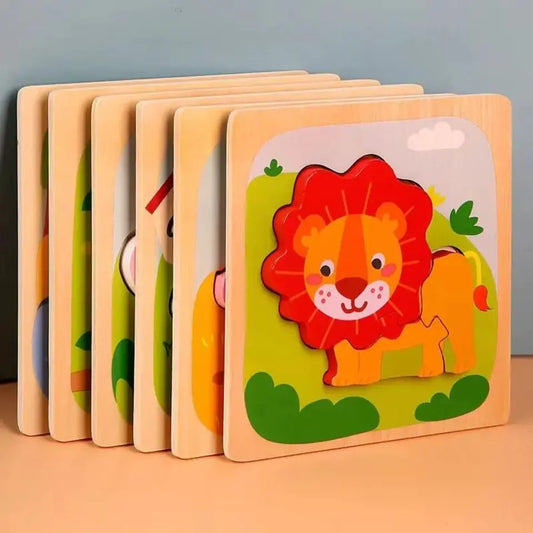
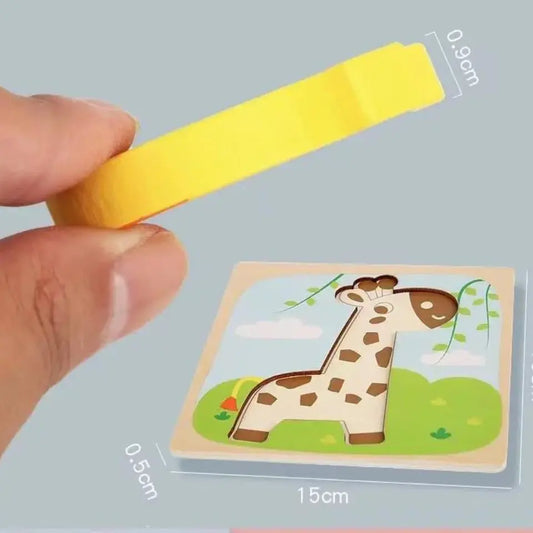

A travel busy board for 6 month old babies needs to meet a much stricter standard than the toddler busy boards commonly sold online. A traditional board with buckles, switches, removable shapes, zips, laces or multiple hard components is generally not the default choice for a six-month-old. Instead, only consider a low-complexity soft activity product when the manufacturer explicitly includes six months in its age guidance and the design has no loose pieces, accessible magnets or batteries, long cords, or hard protruding parts.

At this age, assume anything within reach may be grasped, pulled, dropped or explored with the mouth. ACCC Product Safety specifically warns that babies and toddlers commonly explore toys by sucking and chewing, making small or detachable components particularly important to consider.
| Travel-toy question | What to check at six months | Safer approach |
|---|---|---|
| Is it age-appropriate? | Manufacturer explicitly includes six months | Avoid relying on “Montessori” or marketplace titles alone |
| Can anything detach? | No loose or small parts | Choose permanently attached features |
| Does it contain electronics? | No accessible batteries | Prefer simpler non-electronic toys |
| Is it suitable for mouthing? | Smooth, secure and easy to clean | Avoid rough edges and fragile finishes |
| Is it practical for travel? | Lightweight, compact and washable | Check exact dimensions and weight |
| Can it be used safely? | Active adult supervision | Pack it away for sleep and when not in use |
Related Products
Can a 6-Month-Old Use a Travel Busy Board?
Yes, but only some products that are described as busy boards are potentially appropriate for a six-month-old. The important factor is not the product name. It is the manufacturer's age grading, construction and individual features. ACCC guidance advises parents to choose toys suitable for the baby's age and states that toys intended for babies and toddlers should be labelled as suitable for children aged three years and under.

Many traditional busy boards are designed around toddler skills such as operating buckles, fastening buttons, threading laces, opening locks or matching removable pieces. For a six-month-old, a simpler baby sensory board for travel, soft activity panel or baby activity book will often make more sense than trying to find the board with the greatest number of activities.
The Quick Answer for Parents
A six-month-old should only use a travel activity product when its manufacturer explicitly includes that age and the entire product can withstand the way a young baby is likely to handle it. A “6+ months” label is useful, but parents should still inspect the construction and follow the manufacturer's instructions.
| Question | If the answer is “no” |
|---|---|
| Does the manufacturer explicitly include six months? | Do not use it |
| Is there no under-three small-parts warning? | Do not use it |
| Are all elements permanently attached? | Do not use it |
| Is it free from accessible magnets and batteries? | Do not use it |
| Is it soft or sufficiently lightweight? | Choose another format |
| Can an adult supervise continuously? | Do not use it |
| Can it be cleaned and dried properly? | Choose another toy |
| Can it be stored safely during travel? | Choose another toy |
What Can a Six-Month-Old Do With a Travel Activity Toy?
For travel, it is better to plan around simple sensory interaction than complicated “busy board” tasks. Assume the baby may grab a section, squeeze it, pull it towards their mouth, shake it, turn it around or drop it repeatedly. The toy therefore needs to remain safe even when it is not being used in the neat way shown in a product photograph.
Simple textures, soft flaps, crinkle materials and securely integrated sensory elements can provide something for an awake baby to explore. There is no need for 37, 45 or 54 different activities. A larger activity count does not make a product more age appropriate, educational or useful. At six months, safe simplicity matters more than feature count.
What Makes a Travel Activity Panel Suitable for a Six-Month-Old?
Start with the manufacturer's age recommendation. Do not assume that a listing containing phrases such as “baby busy board”, “Montessori”, “sensory toy” or “travel toy” has been designed for a six-month-old. Check the actual packaging, product instructions and safety warnings.
Then inspect the physical construction. Look for securely stitched seams, permanently attached elements, smooth surfaces and an overall size that is practical for supervised use. ACCC guidance highlights hazards including small parts, poorly attached components, cords, sharp edges, magnets and batteries, and recommends regularly checking toys for tearing, brittleness or other damage.
Travel Busy Board Formats Compared for a Six-Month-Old
Different products can all be marketed as busy boards despite being very different physically. This is why comparing formats is more useful than comparing the number of advertised activities.
| Format | Six-month-old suitability | Main points to check |
|---|---|---|
| Soft fabric sensory panel | Potentially suitable if explicitly age graded | Seams, attachments, loops and washable materials |
| Soft activity/crinkle book | Often a more practical format | Secure pages, no loose decorations and easy cleaning |
| Felt toddler busy book | Usually designed for older children | Removable felt pieces, buttons, cords and fasteners |
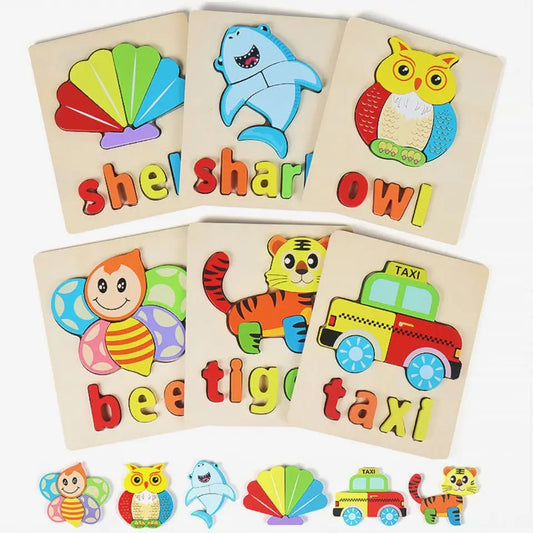
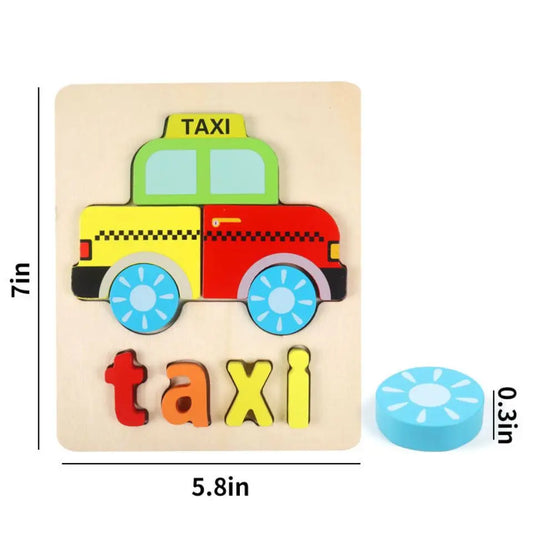
| Wooden busy board | Generally not the default at six months | Weight, hard edges, screws and protruding hardware |
| Busy board cube | Usually better suited to older babies/toddlers | Weight, detachable pieces and hard components |
| Electronic/light-up board | Requires extra scrutiny | Battery compartment, construction and age grading |
Soft Fabric Sensory Panels
A soft panel can be worth considering when the manufacturer specifically includes six months. Prioritise simple textures and permanently attached features rather than decorative components that can be pulled away.
Check every seam, tab and loop before each journey. Fabric construction alone does not make a product automatically safe.
Soft Activity and Crinkle Books
A soft activity or crinkle book may be a more practical busy board for 6 month old travel use because it can be lightweight, compact and easier for an adult to manage on a plane, train or in a restaurant.

Again, check the manufacturer's age recommendation and inspect all stitched components. A book should be removed from use if fabric, filling or decorative parts begin to come loose.
Felt Toddler Busy Books
Many felt busy books contain detachable shapes, buttons, press studs, buckles, laces or matching games. These features may be intended for an older child's fine-motor activities rather than a six-month-old's play.
Do not remove a warning or simply take out one obvious loose piece and assume the remaining book has become appropriate for a baby.
Wooden Busy Boards
Traditional wooden boards are generally not the first format to choose at six months. Their weight, corners and attached hardware can make them less practical for a baby who may suddenly drop or pull the board towards their face.
If the manufacturer does not explicitly include your baby's age, choose another travel activity rather than trying to adapt the board.
Busy Board Cubes
Activity cubes can contain spinning parts, doors, switches and other components that appeal to older babies and toddlers. They may also be considerably heavier and bulkier than soft travel toys.
Check age grading, dimensions and exact product weight rather than relying on photographs that make the cube appear smaller.
Electronic and Light-Up Boards
Electronic products deserve additional scrutiny because the power source becomes part of the safety assessment. ACCC warns that button batteries can cause severe injuries if swallowed or inserted into the body, and battery-operated toys for children up to 36 months are subject to requirements intended to prevent children accessing batteries.
For a six-month-old travel toy, a simple non-electronic alternative may remove unnecessary complexity.
Using a Baby Activity Toy on Different Journeys
The same toy may be practical in one travel situation and inconvenient in another. Consider where the baby will sit, how closely an adult can supervise and where the toy will go when it is not being used.
Plane Travel
Choose something compact enough to retrieve and put away easily while seated. CASA advises parents travelling with infants to plan ahead and supervise their child throughout the flight.
Do not assume that an attachment strap or toy can be fixed to an aircraft bassinet. Bassinet use is subject to aircraft and airline procedures, and CASA notes that bassinets cannot normally be used during critical phases such as take-off and landing. Ask the airline before attaching anything.
Car Travel
A travel activity should never compromise the child restraint, harness position or correct installation. Australian child restraints are designed around the child's age and size, and correct installation and use are essential to their protective function.
Use toys only when they can be managed without changing the restraint set-up. A lightweight soft toy is generally easier to handle than a heavy board during road travel.
Trains and Public Transport
Compactness matters on trains, buses and other public transport because toys are more likely to be dropped or placed on shared surfaces. A washable activity book that fits inside the nappy bag may be more convenient than a large multi-panel board.
Supervise use and inspect the toy again if it has been dropped, caught in luggage or damaged during the journey.
Hotels and Holiday Accommodation
Travel toys should remain awake-time activities. Do not leave a busy board, soft activity book or other toy in a cot or portable sleep space.
Red Nose recommends keeping a baby's sleep space clear of toys and other loose items and, in its current guidance, recommends nothing in the baby's sleep space for the first 12 months.
Restaurants and Waiting Areas
Quiet, lightweight toys can be useful when an adult can supervise closely. Choose a product that is easy to pick up, wipe or wash after contact with tables, floors and other public surfaces.
Avoid using long attachment cords to prevent the toy falling. ACCC identifies cords, ribbons, threads and elastic as potential strangulation hazards for babies and children.
Safety Checks Before Packing a Baby Travel Activity
Before travel, inspect the entire product rather than checking only its most obvious activities. ACCC recommends regularly examining toys and disposing of them when they become broken, brittle, torn or otherwise capable of releasing hazardous components.
Before the Trip
- Confirm that the manufacturer explicitly includes six months.
- Read every age warning and safety instruction.
- Pull gently on stitched and attached components to check for damage.
- Check seams for openings or exposed filling.
- Check for small removable or potentially detachable parts.
- Avoid accessible magnets and batteries.
- Inspect mirrors for damage, sharp edges or insecure attachment.
- Check cords, loops, ribbons and elastic carefully.
- Record the toy's exact dimensions and weight before deciding whether it is genuinely travel friendly.
- Confirm that it can be cleaned according to the manufacturer's instructions.
- Plan where it will be stored when the baby sleeps or must be restrained.
After Travel
- Inspect the toy after it has been dropped or compressed in luggage.
- Look for loose stitching, cracks, stretching or newly exposed components.
- Clean it according to the manufacturer's directions.
- Allow washable products to dry fully before storage.
- Stop using the product if a safety-related component has changed or become damaged.
How to Compare Travel Toys for a Six-Month-Old
When comparing travel toys, focus on age suitability, construction and how practical the toy will be during the journey. The best travel toys for 6 month old baby use should be lightweight, easy to clean and simple enough to inspect before and after travel.
| Feature | What to Look For | Why It Matters |
|---|---|---|
| Age guidance | Clearly suitable from 6 months | Helps confirm the toy is designed for this age group |
| Size and weight | Compact and lightweight | Easier to carry, store and handle during travel |
| Construction | Soft materials with secure parts | Better suited to grabbing, mouthing and dropping |
| Small parts | No loose or detachable pieces | Reduces avoidable safety risks |
| Cleaning | Easy to wipe or wash | Useful after flights, car trips and public transport |
| Travel design | Simple and easy to pack away | Makes the toy more practical for everyday travel |
Safer Travel-Toy Alternatives to a Traditional Busy Board
If no busy board clearly meets the criteria for your baby's age, there is no need to force the category. Consider an age-graded soft crinkle book, simple fabric sensory toy, baby-safe teether, appropriately designed rattle or another lightweight activity whose manufacturer explicitly includes six months.
The same principles apply to travel toys for 6 month old Australia searches: verify age grading, warnings and construction before buying. ACCC advises consumers to choose sturdy, well-made, age-appropriate baby toys and to check them regularly for deterioration.
Frequently Asked Questions
Are Busy Boards Good for Six-Month-Old Babies?
Some soft, simple activity products may be appropriate if the manufacturer explicitly includes six months. Traditional toddler boards should not be treated as suitable by default because their hardware, removable pieces and activities may have been designed for older children.
What Is a Busy Board for Babies?
The term can describe anything from a soft sensory panel to a wooden activity board. Because it is a broad marketing description rather than proof of age suitability, check the manufacturer's actual age recommendation and warnings.
What Should Be on an Activity Board for a Six-Month-Old?
Keep it simple: securely integrated textures, crinkle sections or other soft sensory features can be easier to assess than locks, loose shapes, laces and complex fasteners. Every component should remain securely attached during normal use.
Are Felt Busy Boards Safe for Babies?
Not automatically. Felt toddler books can contain removable shapes, buttons and other small components. Check the stated age range and inspect each attachment rather than assuming felt construction makes the product suitable.
Can a Six-Month-Old Use a Wooden Busy Board?
A wooden board is generally not the default recommendation at this age. If the manufacturer does not explicitly include six months, choose a softer age-appropriate alternative.
Can You Take a Baby Busy Board on a Plane?
A compact toy may be packable for a flight, but baggage and onboard requirements vary by airline and route. Check directly with your airline rather than relying on a universal carry-on claim. CASA also recommends planning ahead when travelling with infants.
Can You Attach a Travel Toy to an Aircraft Bassinet?
Do not assume you can. Aircraft bassinet procedures vary, and CASA explains that bassinets have restrictions on when they can be used. Ask your airline or cabin crew before attaching anything to the bassinet or surrounding fittings.
Can a Baby Use a Busy Board in a Car Seat?
Only if the activity does not interfere with the restraint or correct harness use. Keep the child correctly restrained and favour lightweight options that can be removed easily. Never modify the restraint to accommodate a toy.
Are Light-Up Busy Boards Suitable for Six-Month-Olds?
Do not assume so. Check the manufacturer's age grading and battery construction carefully. ACCC warns about the serious hazards associated with button batteries and requires secure battery compartments on applicable battery-operated toys for young children.
How Do You Clean a Baby Travel Activity Panel?
Follow the manufacturer's instructions because materials vary. Check whether the product is machine washable, hand washable or surface clean only, and inspect seams and attachments again after cleaning.
Will a Busy Board Keep a Baby Quiet During a Flight?
There is no guarantee. Babies respond differently to toys, feeding, sleep, unfamiliar surroundings and changes in routine. Pack a small selection of familiar, age-appropriate items instead of relying on one toy to keep a baby settled for an entire journey.
Choose an Age-Appropriate Travel Activity, Not a Marketing Label
When choosing a travel busy board for 6 month old babies, the safest starting point is not the words “busy board”, “Montessori” or the number of activities printed on a listing. Look first for explicit manufacturer age guidance, then examine the product's construction, weight, dimensions, cleaning requirements and potential hazards.
For many six-month-olds, a simple soft activity book or age-graded sensory toy may be a more practical travel option than a traditional toddler board. Toys4us does not recommend assuming that any current busy board is suitable for six months without product-specific manufacturer guidance. Browse age-appropriate baby toys instead, compare the safety information carefully, and choose the simplest option that fits your baby's age and your journey.