

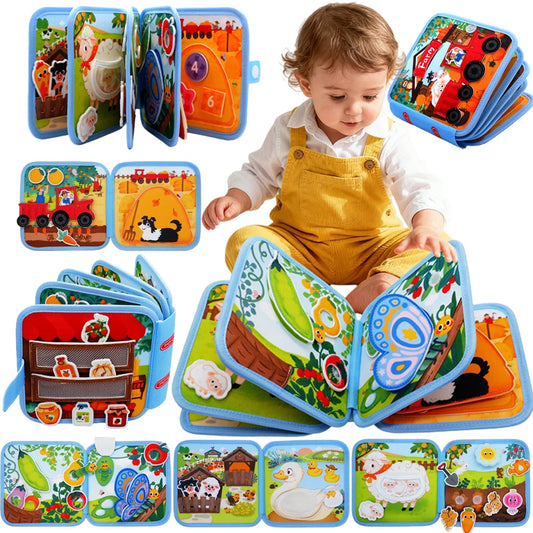
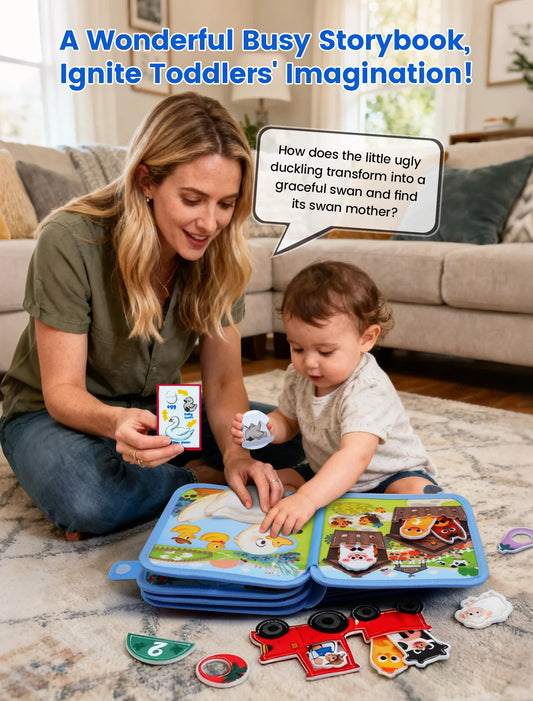
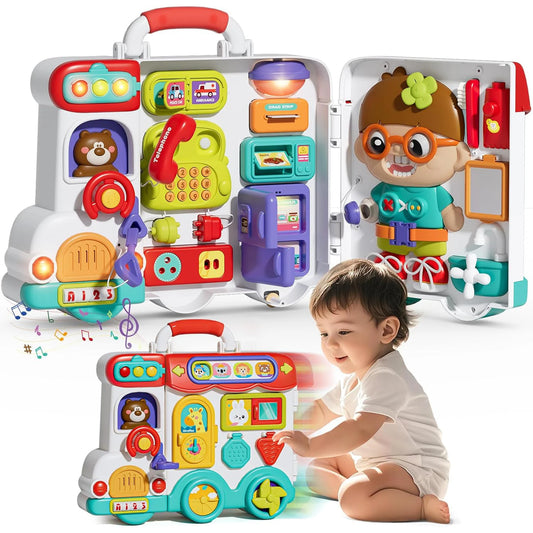
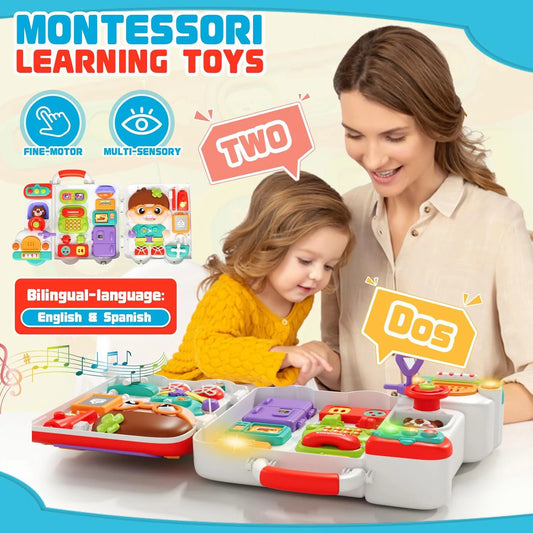
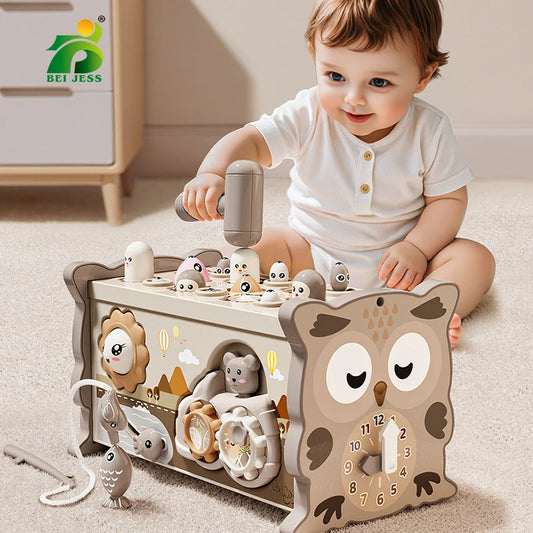
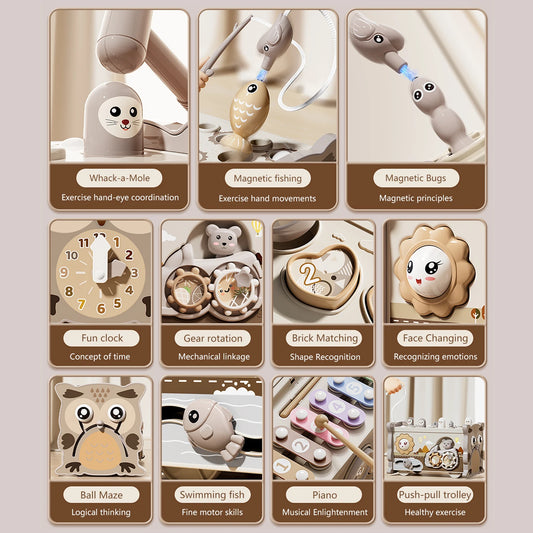

A travel busy board can give babies, toddlers and preschoolers a compact way to explore hands-on activities when the family is away from home. Depending on the design, it may include zips, buckles, wheels, sliders, switches, textures, flaps, matching activities or simple lights and sounds.
However, a product does not become travel-friendly simply because “travel” appears in its name. Size, weight, age grading, secure components, cleaning requirements and how comfortably it can be used in a plane seat, car or restaurant all matter. This guide explains how to compare the main types and choose a board that suits both your child and the journey.
What Is a Travel Busy Board?
A travel busy board is a compact activity board, book or cube designed for hands-on play away from home. It takes familiar busy-board activities and packages them in a format that is easier to carry, store and use in relatively confined spaces.
Common formats include felt busy books, foldable activity boards, small wooden boards, activity cubes and electronic switch boards. Some focus on practical fasteners such as zips and buckles, while others feature textures, wheels, switches, matching games or cause-and-effect elements.
Related Product
What Makes a Busy Board Suitable for Travel?
A useful busy board for travelling should be judged by more than appearance. Start with the recommended age, then check the dimensions, weight, closure, activity security, noise level, cleaning instructions and durability. The activities should also be manageable in the space where your child is likely to use them.

If you are assembling a broader travel-toy kit rather than relying on one activity, Best Toddler Toys Under $50 can also help you compare compact and affordable options that can be rotated throughout a journey.
Check the Recommended Age First
The manufacturer’s age grading should always come before assumptions based on words such as “baby”, “toddler” or “Montessori”. Some activity boards marketed towards young children may still carry a 3+ recommendation because of their components or construction.
Check both the packaging and online product specifications. If the age information conflicts between sources, seek clarification from the supplier before buying. ACCC Product Safety also advises choosing toys that are appropriate for the child’s age and sturdy enough not to break into small components.
Look for a Lightweight and Compact Design
Check the exact dimensions and weight before ordering. Consider whether the board fits inside your backpack or cabin bag and whether your child can comfortably use it on their lap or a tray.
Foldable designs can be convenient for flights and restaurants, while slightly larger boards may suit car trips or accommodation. There is no universal ideal busy board travel size.
Choose Secure Activities Without Loose Pieces
Loose pieces can disappear under car seats, fall between aircraft seats or become scattered around waiting rooms. Permanently attached activities are often easier to manage while travelling.
Check buttons, beads, decorations, matching pieces and hook-and-loop attachments carefully. Magnets should remain completely secure. For broader safety guidance, see Are Montessori Toys Safe for Babies?
Consider Noise, Lights and Batteries
Quiet activities are usually more suitable for planes, restaurants and shared waiting areas. Repetitive sounds or bright flashing lights may also be distracting for some children.
For electronic boards, make sure the battery compartment is securely closed and undamaged. When flying, check current airline requirements for battery-powered toys and protect the device from accidental activation.
Check How Easy It Is to Clean
Travel toys can touch seats, tables, luggage and floors, so cleaning is worth considering. Felt, wood, plastic and electronic boards all have different care requirements.
Follow the manufacturer’s instructions. Fabric should dry completely before packing, while electronic boards should not be soaked unless specifically designed for it.
Types of Travel Busy Boards Compared
Different travel busy board formats suit different journeys. A felt book may work well in cabin luggage, while a wooden board or cube can be more practical once the family reaches its accommodation.
Always check the recommended age, dimensions and product specifications before buying. You can also compare different formats in the broader Busy Board range.
Felt Travel Busy Books
Felt travel busy books are lightweight, foldable and usually quiet. Multiple activity pages can also fit into a relatively small package.
Check for weak stitching, detachable matching pieces, long laces and small buttons. Some felt books are recommended only for children aged three and over.
Portable Montessori Busy Boards
A portable Montessori busy board may include zips, buckles, buttons, laces and other practical activities that work well for hands-on play.
However, “Montessori” is often used as a marketing term. The board still needs to be assessed for age suitability, construction, portability and activity difficulty. Browse Busy Board options based on these practical factors rather than the label alone.
Wooden Travel Busy Boards
Wooden boards provide a firm surface for switches, wheels and latches and can be relatively durable when well constructed.
For travel, consider their weight and size. Check for sharp corners, splinters, exposed screws or loose hardware before packing.
Travel Busy Board Cubes
Activity cubes provide several play surfaces in one toy, making them useful in hotels or holiday accommodation.
Their main disadvantage is bulk. Check whether the cube sits securely on a lap or table and whether it can be packed without taking up excessive space.
Electronic and Light-Up Busy Boards
Electronic boards can offer switches, lights and simple cause-and-effect activities, but they are not automatically better for travel.
Check battery security, sound controls and durability. For flights, also review current airline requirements for battery-powered devices.
Choosing a Travel Busy Board for Different Journeys
The best board depends on where it will be used. A compact book may be practical during transit, while a larger board can work better once the family reaches its destination.
Travel Busy Boards for Plane Trips
For flights, look for low weight, compact dimensions, quiet activities and secure components. Ideally, the board should work comfortably on a lap or tray table and pack away quickly.
Electronic models require additional battery checks. Always review current airline rules rather than assuming a product is universally “airline-approved” or “TSA-approved”.
Busy Boards for Car Travel
For busy board travel by car, securely attached components can prevent children from constantly dropping pieces onto the vehicle floor.
The board should never interfere with a correctly fitted child restraint. Heavy boards also need careful storage, and the driver should not attempt to retrieve dropped toys while driving.
Busy Boards for Restaurants and Waiting Rooms
A compact portable Montessori busy board can suit restaurants and waiting rooms when it offers quiet activities that do not need a large table.
Look for easy cleaning, attached components and quick packing. A busy board can provide another activity option, but it will not guarantee that a child remains settled.
Busy Boards for Hotels and Holiday Accommodation
Larger wooden boards and cubes may work better in accommodation than during transit because there is usually more space to use and store them.
After travelling, inspect the board for damage and make sure all pieces remain secure and accounted for.
Which Travel Busy Board Activities Suit Different Ages?
Age bands can help guide your choice, but the manufacturer’s specific age grading should always take priority.
Travel Busy Boards for Babies
A travel busy board for baby use should only be chosen when the manufacturer specifically recommends the product for babies.
Look for large tactile features, simple flaps and securely attached components. Mouthing behaviour, cleaning and close supervision are especially important at this age.
Travel Busy Boards for One-Year-Olds
One-year-olds may enjoy large sliders, secure wheels, simple switches and basic opening-and-closing activities.
Choose simple tasks without accessible small parts. See Choosing the Best Toys for 1 Year Old Toddlers for additional age-appropriate travel toy ideas.
Travel Busy Boards for Two-Year-Olds
A travel busy board for toddlers around age two may include large buckles, zips, simple matching activities and easy latches.
Activities should offer some challenge without becoming frustrating. You can also compare other options in Best Toys for 2 Year Old Toddlers.
Travel Busy Boards for Children Aged 3–6
Older preschoolers may enjoy dressing activities, numbers, letters, sequencing, matching and multi-step fasteners.
Many current busy-board designs are aimed at this age group, but individual age recommendations and construction still need to be checked.
Travel Busy Board Safety Checklist for Australian Families
Travelling can increase wear because busy boards are repeatedly packed, carried and used in different environments. Check the board regularly for damaged stitching, loose hardware, small parts, exposed batteries, magnets, cords or sharp areas.
Australian families should also follow ACCC Product Safety guidance and check relevant recalls when necessary. For more information about toy safety, see Are Montessori Toys Safe for Babies?
Safety Checks Before Buying
Before purchasing, check:
- Recommended age
- Dimensions and weight
- Securely attached components
- Magnets or small pieces
- Long cords or straps
- Secure battery compartment
- Cleaning instructions
- Consistent age information
- Current product recalls
Safety Checks Before Packing
Inspect the board before every trip. Gently test attached components, check stitching and hardware and look for cracks, splinters or damaged electronic parts.
Make sure the board closes properly and remove it from use if any important component has become damaged or loose.
Safety Checks During the Journey
Follow the product’s supervision guidance and stop play if a component becomes loose.
Keep boards away from child-restraint fittings, store them safely when not in use and keep electronic products dry. Airline instructions should also be followed for battery-powered items.
What Can Children Practise With a Travel Busy Board?
A travel busy board can offer opportunities to practise grasping, turning, sliding, opening, closing and simple hand-eye coordination. Activities such as zips and buckles may also introduce everyday dressing-related actions.
Boards may encourage hands-on exploration and provide a quiet, screen-free play option while travelling. They should not be expected to guarantee calm behaviour, prevent tantrums or deliver specific developmental outcomes.
For more hands-on learning options, see Best Educational Toys Under $50.
How to Pack and Use a Busy Board While Travelling
Inspect the board before leaving and pack it somewhere an adult can reach easily. A washable pouch or protective bag can also help keep it clean and contained.
For practical busy board for traveling use:
- Inspect the board before leaving.
- Check that components are secure.
- Keep it within adult reach.
- Use a washable storage pouch.
- Introduce a few activities at a time.
- Rotate it with another quiet toy.
- Avoid showing every activity immediately.
- Clean it as directed.
- Inspect it after travelling.
- Store it clean and dry.
Interest will vary between children, so follow your child’s preferences rather than expecting the board to work for a fixed amount of time.
Frequently Asked Questions About Travel Busy Boards
What Is the Best Travel Busy Board for a Toddler?
The best option matches the manufacturer’s age guidance and is compact, lightweight, quiet and easy to clean.
Secure components are particularly useful for travel, but the ideal format still depends on the child and journey.
Can You Take a Busy Board on a Plane?
Most ordinary toys can generally be packed when they do not contain prohibited items, but airline rules should always be checked before travelling.
Electronic boards and battery-powered toys may require additional checks.
Are Busy Boards Good for Car Travel?
Compact busy boards can provide hands-on activities during car journeys, particularly when all pieces stay securely attached.
They should never interfere with the child restraint, and heavy rigid boards need careful storage.
What Size Should a Travel Busy Board Be?
There is no universal ideal size. The board should fit comfortably in your intended bag and be manageable on the child’s lap or available surface.
Check exact dimensions before ordering.
Are Felt Busy Books Safe for Toddlers?
Suitability depends on age grading, stitching, attached components, cords and overall condition.
Felt may be soft and lightweight, but that does not automatically make every felt book suitable for every toddler.
Are Electronic Busy Boards Suitable for Air Travel?
They may be suitable, but battery type, secure battery compartments, accidental activation and airline requirements should be considered.
Check your airline and current CASA guidance before flying.
How Do You Clean a Travel Busy Board?
Cleaning depends on the material. Felt may require spot cleaning, while wooden products should be cleaned according to their finish.
Electronic parts should generally be kept dry unless the manufacturer says otherwise.
Can Children Use a Travel Busy Board Without Supervision?
Follow the manufacturer’s instructions and consider the child’s age and behaviour.
Travel introduces confined spaces and dropped components, so adult monitoring may still be appropriate.
How Long Will a Travel Busy Board Keep a Child Occupied?
There is no fixed time. Interest depends on age, mood, fatigue, familiarity and the difficulty of the activities.
Rotate the board with other activities and follow the child’s interest instead of expecting a set duration.
Is a Busy Board Really a Montessori Toy?
Many commercial boards are better described as Montessori-inspired.
Using the word “Montessori” does not certify safety, quality, age suitability or educational value.
Choosing the Right Travel Busy Board for Your Next Trip
When choosing a travel busy board, start with the manufacturer’s age grading and then compare size, weight, activity security, noise, batteries and cleaning requirements. The best format should also match how you plan to travel, whether by plane, car or during a longer holiday stay.
Inspect the board before each journey and stop using it if components become damaged or loose. When comparing the Busy Board range, check each product’s recommended age, dimensions and travel-friendly features before making your choice.