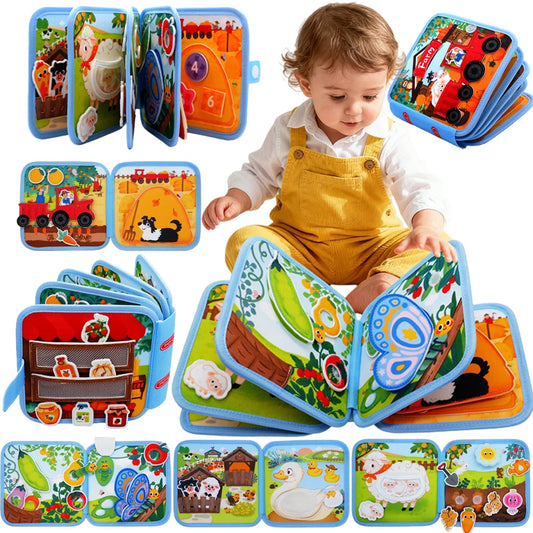
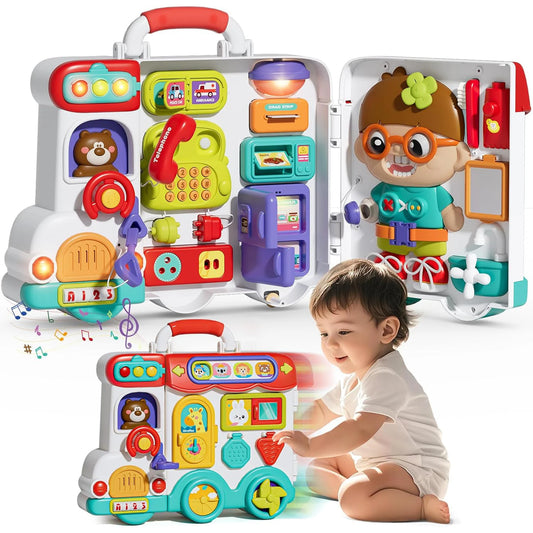
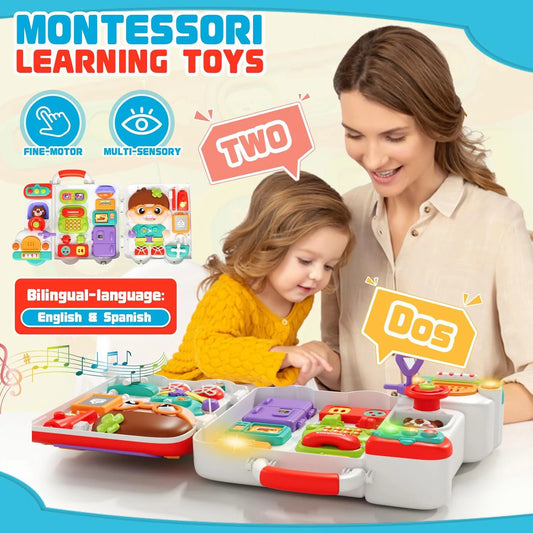
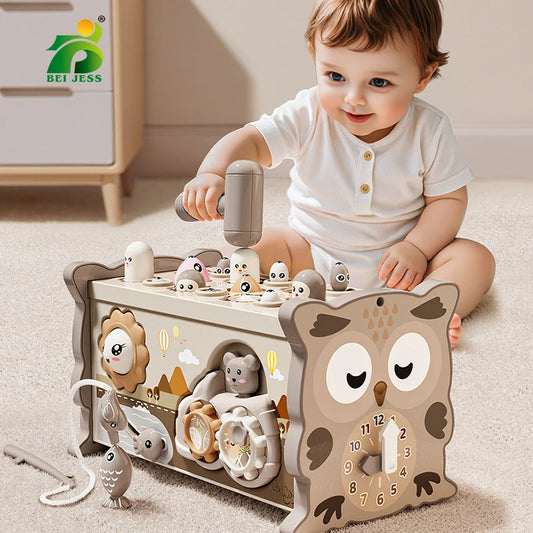
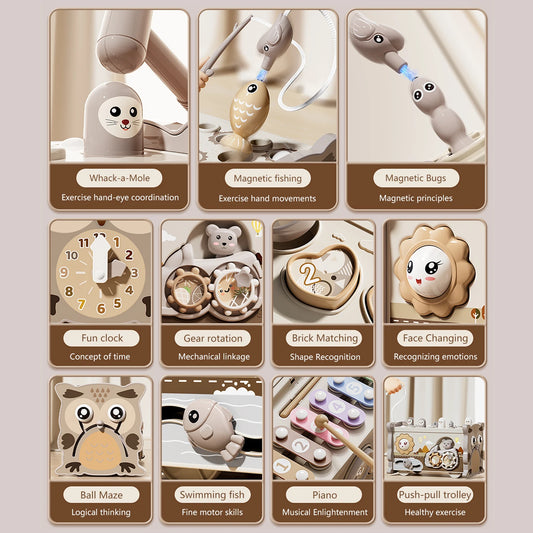

Choosing a travel busy board for a 1 year old starts with age suitability, not portability or the number of activities. The best option is a lightweight, compact product whose manufacturer explicitly recommends it for your child’s current age, with securely attached activities, no accessible small parts, detachable magnets or batteries, short and safe straps, smooth construction and clear cleaning instructions. Words such as “Montessori”, “toddler”, “baby” or “travel” do not prove suitability, so always check the manufacturer’s formal age recommendation first.
| What to Check | What to Look For | Why It Matters |
|---|---|---|
| Recommended age | Manufacturer explicitly includes your child’s current age | Product names alone do not confirm age suitability |
| Small parts | No under-three small-parts warning or detachable pieces | Small components may create choking risks |
| Magnets | No detachable or accessible magnets | Loose magnets can cause serious injuries if swallowed |
| Batteries | No accessible batteries or unsecured compartments | Battery access can create serious safety risks |
| Cords and loops | No long cords, laces or loops | Helps reduce entanglement and strangulation hazards |
| Size | Check open and folded dimensions | Confirms whether it fits your travel bag and available play space |
| Weight | Lightweight enough for the intended journey | Heavy boards can be inconvenient for flights or public transport |
| Activities | Simple, securely attached activities | More activities do not automatically make a board more suitable |
| Construction | Smooth edges, secure stitching and durable fasteners | Travel can loosen or damage components |
| Cleaning | Clear manufacturer cleaning instructions | Travel toys often need regular cleaning |
| Inspection | Easy to check before and after use | Damage can make previously secure components unsafe |
| Storage | Easy to protect and store between uses | Helps prevent damage and lost components |
What Is the Best Travel Busy Board for a 1 Year Old?
The best travel busy board for a one-year-old is a lightweight, compact product whose manufacturer explicitly recommends it for the child’s age. It should have securely attached activities, no accessible small parts, magnets or batteries, short and safe straps, smooth construction and clear cleaning instructions. Check the actual age label rather than relying on “toddler”, “travel” or “Montessori” in the product title.

There is no single best travel busy board for a 1 year old for every family. A soft felt book may work well when luggage weight matters, while a compact wooden board can offer a firmer play surface. Start with age and safety, then consider where you will use it. The same approach applies when Choosing the Best Toys for 1 Year Old Toddlers generally.
The Quick Selection Checklist
Before buying, check:
- Manufacturer explicitly covers your child’s current age
- No under-three small-parts warning
- No loose or detachable magnets
- No accessible batteries
- No loose shapes, cards or matching pieces
- No long cords, laces or loops
- Lightweight enough for your journey
- Compact enough for your chosen bag
- Activities are simple enough for your child
- Smooth, durable construction
- Zips and fasteners are securely attached
- Clear cleaning instructions
- Easy to inspect before and after travel
- Practical storage method between uses
If several of these points are unclear on the listing or packaging, consider a different product rather than assuming it is suitable.
Related Products
Can a One-Year-Old Use a Travel Busy Board?
A one-year-old can use a busy board when the specific product is designed and labelled for that age. ACCC guidance says babies and toddlers are particularly vulnerable to choking because they commonly explore objects with their mouths. Toys for children up to and including 36 months are therefore subject to mandatory requirements intended to reduce risks from small components becoming accessible during normal use or reasonable wear.
Needs also change considerably across the broad 12–24-month period. A child around 12–18 months may be better suited to large switches, securely fixed flaps, simple sliders and easy-to-grasp fasteners. An older child around 18–24 months may be interested in more complex zips, buckles or simple matching activities. These are practical comparisons rather than rigid developmental milestones; the child’s abilities and the manufacturer’s age grading remain more important.
What Makes a Busy Board Suitable for Travel?
A good portable busy board for 1 year old should balance safety, size, weight and durability. Check the product’s open dimensions, folded dimensions and actual weight rather than relying on descriptions such as “compact”. A board measuring 30 cm across may look small online but still be awkward on an aircraft tray table or in a crowded restaurant.
Travel also puts additional stress on toys. Busy boards may be squeezed inside luggage, dropped, dragged by handles or straps, exposed to spills and repeatedly opened and closed. Look at how activities are attached, whether edges can become damaged and whether the product can be inspected easily after a journey.
Types of Travel Busy Boards for One-Year-Olds Compared
Different formats suit different journeys. This table provides a starting point, but the manufacturer’s age information should be checked for every individual product.
| Format | Travel advantages | Points to check |
|---|---|---|
| Felt busy book | Light, foldable, easy to pack | Loose felt pieces, stitching, buttons, cords |
| Wooden board | Firm and durable | Weight, corners, screws, detachable hardware |
| Busy board cube | Activities on several sides | Bulk, weight, loose components |
| Montessori-inspired board | Often simple and practical | “Montessori” does not establish age suitability |
| Electronic board | Lights and switches may add variety | Battery type, compartment security, airline rules |
Felt Travel Busy Books
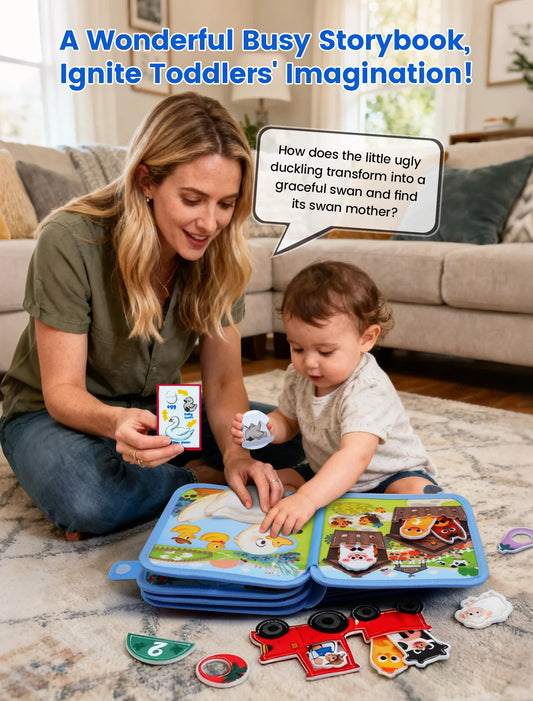
Felt books are often among the easiest formats to pack because they are lightweight and can fold relatively flat. They may be practical as quiet travel toys for 1 year old children in restaurants, waiting rooms or on public transport.
However, inspect every activity individually. Decorative buttons, removable felt shapes, small buckles, beads and poorly secured attachments may be inappropriate for younger children. Stitching can also deteriorate after repeated folding, washing and travel.
Wooden Travel Busy Boards
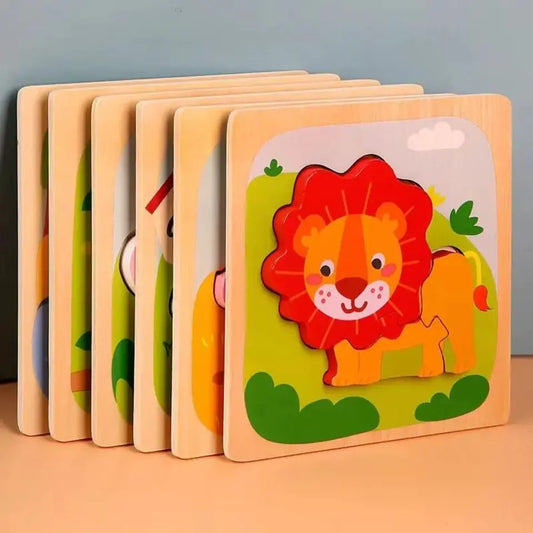
Wooden boards usually provide a more stable surface and may withstand repeated use better than very soft formats. Compact boards with integrated handles can work for hotel rooms, train journeys and other situations where luggage space is less restrictive.
Weight is the major trade-off. Check the exact kilograms or grams before buying, together with the dimensions. Inspect edges, corners, screws, hinges and attached hardware carefully. Any wooden product that becomes cracked, splintered or damaged should be taken out of use.
Travel Busy Board Cubes
Busy-board cubes put activities on several surfaces, which can make them compact relative to the number of activities offered. However, they usually take up more three-dimensional luggage space than a felt book or flat board.
Check whether the cube includes removable pieces and whether handles, doors or other components can detach. A cube may be more appropriate for a hotel room than a narrow aircraft seat simply because it requires more space to position and turn.
Montessori-Inspired Travel Boards
A Montessori-inspired travel board may feature everyday-style actions such as switches, zips, buckles and sliders. These can create a simple format without screens or electronic effects.
However, “Montessori” is a design or marketing description rather than evidence that a product is suitable for a particular age. The same applies to “baby” and “toddler”. Families comparing these products may also find Are Montessori Toys Safe for Babies? useful when assessing individual components.
Electronic and Light-Up Busy Boards
Electronic busy boards may include illuminated buttons, switches or sound effects. For a one-year-old, however, the battery system deserves particularly careful attention. Australian requirements for battery-operated toys intended for children up to 36 months include securing the battery compartment so that access requires a tool. Button and coin batteries present particularly serious risks if swallowed or inserted into the body.
For air travel, also identify the battery type before packing. CASA has specific requirements for lithium batteries and battery-powered devices, and airline-specific limits can apply.
Choosing a Travel Busy Board for Different Journeys
The best travel busy board for a 1 year old depends partly on where it will be used. Portability can mean something different on an aircraft than it does during a hotel stay, so compare the product with the actual journey rather than looking for one universal travel solution.
Plane Travel
For an airplane busy board for 1 year old, compact dimensions matter. A lightweight felt book or small flat board may be easier to manage around tray tables, seat pockets and cabin baggage than a large wooden cube. Avoid loose pieces that can disappear underneath seats.
If the board uses batteries, consult CASA guidance and check the operating airline’s current baggage rules before departure. Do not assume that a product being described as a “travel toy” means every airline will treat it identically.
Car Travel
A car travel activity should never compromise the correct use of the child restraint. Avoid positioning a rigid or bulky busy board beneath straps, behind the child or anywhere it changes restraint fit.
A soft, appropriately sized activity may be easier to manage, but it still requires supervision when practical. Keep loose components out of the seating area and remove the toy if it becomes damaged.
Trains and Public Transport
Compact felt books and flat boards can be practical on trains because they fit into smaller bags and require little setup. A handle can also help when families are moving between platforms.
Choose activities that remain attached to the board. Loose matching cards, shapes or accessories are easier to drop in public areas and may become difficult to keep clean.
Restaurants and Waiting Rooms
For restaurants and waiting rooms, portability and wipeability may matter more than having numerous activities. A small board that can be placed on a table or held comfortably may be more practical than a complicated model with dozens of components.
No travel toy can promise that a child will remain quiet or occupied for a particular period. Treat a busy board as one possible activity rather than a guarantee of behaviour.
Hotels and Holiday Accommodation
Hotels offer more space, so a slightly larger wooden board or cube may be manageable if luggage capacity allows. A familiar activity can also be included among several toys rather than becoming the sole entertainment option.
Store the busy board away when it is not being supervised, particularly if the accommodation is shared with older children whose toys contain smaller components.
Travel Busy Board Safety Checks for a One-Year-Old
Start with the age label and then inspect every component. Look for small parts, detachable magnets, accessible batteries, loose buttons, long cords, loops, ribbons, zips, buckles and fasteners. ACCC advises against giving babies toys with small parts that can break away and identifies cords, ribbons, threads and elastic longer than 22 cm as potential strangulation hazards.
Magnets deserve particular caution. ACCC warns that swallowed magnets can cause serious internal injuries and recommends ensuring magnets are securely attached or embedded. If a board includes a mirror, check that it is designed as part of the toy, securely fixed and free from damaged or sharp edges. Do the same for zips, hinges and other hardware rather than assuming familiar household-style components are automatically safe.
How to Compare Travel Busy Boards Before Buying
Do not compare products only by activity count or price. Create a shortlist and record the information that matters for your child and journey.
| Comparison point | Product A | Product B |
|---|---|---|
| Manufacturer recommended age | ||
| Under-three warning | ||
| Open dimensions | ||
| Folded dimensions | ||
| Weight | ||
| Removable pieces | ||
| Magnets | ||
| Battery type | ||
| Long cords or loops | ||
| Cleaning method | ||
| Return policy | ||
| Suitable for intended journey? |
Confirm the Exact Recommended Age
Find the manufacturer’s age range on the packaging, product instructions or verified listing. “Toddler busy board” is not specific enough because toddler-labelled products may target children considerably older than 12 months.
For an age-one purchase, prioritise products explicitly intended for the relevant age rather than trying to interpret marketing language.
Check Dimensions and Weight
Record the exact height, width, depth and weight. For folding products, check both open and folded dimensions.
Then compare those measurements with your carry-on, day bag, pram storage or other luggage. This is more reliable than relying on photographs.
Review Every Activity and Component
Zoom in on product photographs and read the component description. Check whether shapes, buckles, keys, cards, screws, beads or other parts detach.
If important safety information cannot be confirmed, select another product rather than assuming the component is secure.
Check Cleaning Instructions
Travel toys may encounter food, floors, aircraft seats and shared surfaces. Find out whether the board can be machine washed, hand washed or wiped only.
Follow the manufacturer’s cleaning instructions because soaking or aggressive washing may damage adhesives, timber, electronics or stitching.
Verify Current Availability and Returns
Check current stock, shipping times and the retailer’s return conditions immediately before ordering. Product designs and specifications can change, so compare the information for the exact version being sold.
If you cannot verify the recommended age or important safety details, an alternative toy with clearer documentation can be a better purchase.
How to Pack and Use a Busy Board While Travelling
Inspect the board before packing. Pull gently on fixed components, check stitching, examine fasteners, look for cracks or sharp edges and confirm battery compartments remain secure. Pack it where it will not be crushed by heavy luggage, and keep any manufacturer instructions you may need.
Inspect it again after the journey. Travel damage can loosen stitching, hardware and attachments even when the toy appeared safe before departure. ACCC recommends regularly checking toys for breakage, brittleness, tearing or components that are beginning to fall apart.
When Another Travel Toy May Be a Better Choice
A busy board is not essential for travelling with a one-year-old. If you cannot find one with clear age grading and suitable components, choose another age-appropriate activity instead. A sturdy board book, securely constructed sensory toy or another manufacturer-approved travel toy may provide a simpler option.
You can explore Best Toddler Toys Under $50, Best Educational Toys Under $50, Busy Board, What Are Busy Boards? A Parent’s Guide to Types, Benefits and Uses or Travel Busy Board: How to Choose the Right One for Your Child when comparing alternatives.
Frequently Asked Questions
What Is the Best Type of Travel Busy Board for a 1 Year Old?
There is no universally best format. A lightweight felt book may suit flights and small bags, while a compact wooden board may suit journeys where weight is less important. Whichever format you choose, the manufacturer should explicitly recommend it for your child’s age.
Are Felt Busy Boards Safe for One-Year-Olds?
Some can be suitable, but felt construction alone does not make a busy board safe. Check its formal age recommendation, stitching and every attached component. Avoid products with accessible small parts, loose decorative pieces or unsuitable cords.
Is a Wooden Travel Busy Board Too Heavy?
Not necessarily. Check the exact weight rather than assuming all wooden boards are heavy. A compact wooden board may be manageable for a car or train journey but less convenient when every gram of cabin baggage matters.
Can a One-Year-Old Use a Busy Board on a Plane?
Yes, provided the individual product is age-appropriate and it can be used safely in the available space. Keep loose pieces contained and follow crew instructions throughout the flight.
Are Busy Boards Allowed in Carry-On Luggage?
There is no sensible universal answer for every board, airline and itinerary. A simple non-electronic toy may be straightforward to pack, while batteries or unusual components can introduce additional requirements. Check the current rules of your operating airline before departure.
Can You Take a Battery-Powered Busy Board on a Plane?
Potentially, but identify the battery type first. CASA provides specific packing requirements for lithium-powered devices and states that airline limits may also apply. Spare lithium batteries and power banks have additional cabin-baggage requirements. Check CASA and your operating airline before travelling.
Are Magnetic Busy Boards Suitable for Travel?
For a one-year-old, detachable or accessible magnets should be avoided. ACCC warns that swallowed magnets can cause severe internal injuries and advises checking that magnets in toys remain securely attached or embedded.
Can a Child Use a Busy Board in a Car Seat?
Only if it does not interfere with the child restraint or alter how the harness fits. Do not place bulky objects beneath restraint straps or position a rigid board in a way that compromises correct restraint use.
How Do You Clean a Felt Travel Busy Board?
Follow the product manufacturer’s instructions. Some felt boards can be gently hand cleaned, while others contain adhesives, stiff inserts or components that should not be soaked. Check that all parts remain securely attached after cleaning and allow the product to dry completely before storage.
How Many Activities Should a Travel Busy Board Have?
There is no ideal number. For a one-year-old, a smaller selection of secure, age-appropriate activities can be more suitable than a board containing many complicated components. Safety, usability, dimensions and weight matter more than activity count.
Will a Busy Board Keep a One-Year-Old Quiet During a Flight?
There is no guarantee. Children vary in how long they interact with any toy, particularly when tired or in an unfamiliar environment. A busy board can be one activity in your travel bag, alongside other age-appropriate toys, books and comfort items.
Choose Age Guidance and Safety Before Portability
When selecting a travel busy board for 1 year old, start with the manufacturer’s formal age recommendation and inspect the individual product rather than relying on descriptions such as “Montessori”, “baby”, “toddler” or “travel”. Then compare small-parts risks, magnets, batteries, cords, dimensions, weight, cleaning requirements and how well the format suits your journey. Australian parents can also use ACCC Product Safety guidance when checking toys intended for young children.
For flights, check CASA guidance and your operating airline’s current rules, particularly when the board contains batteries. If no busy board offers sufficiently clear age and safety information, choosing another well-documented, age-appropriate travel toy is a perfectly reasonable alternative. You can also compare Best Busy Board for a 1 Year Old and How to Make a Busy Board for a 1 Year Old: Safety-First Guide before deciding what suits your family.