
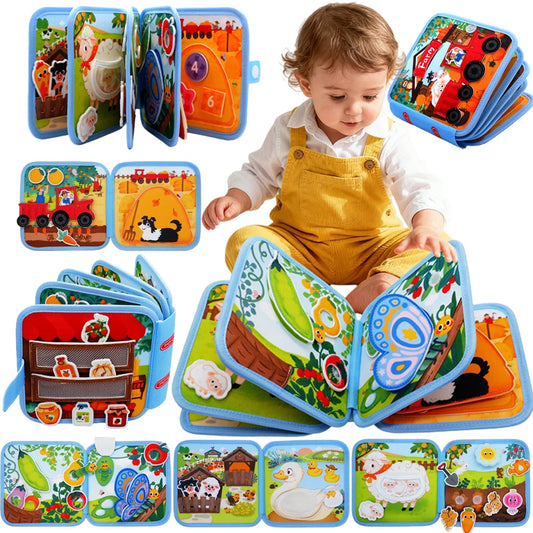
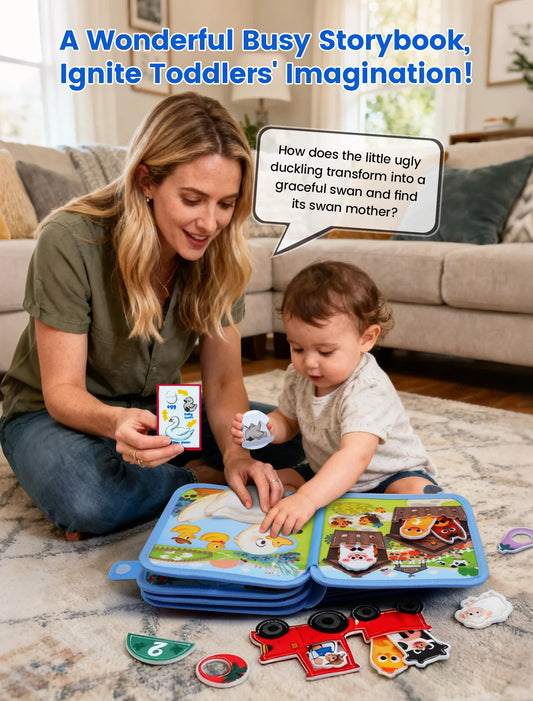
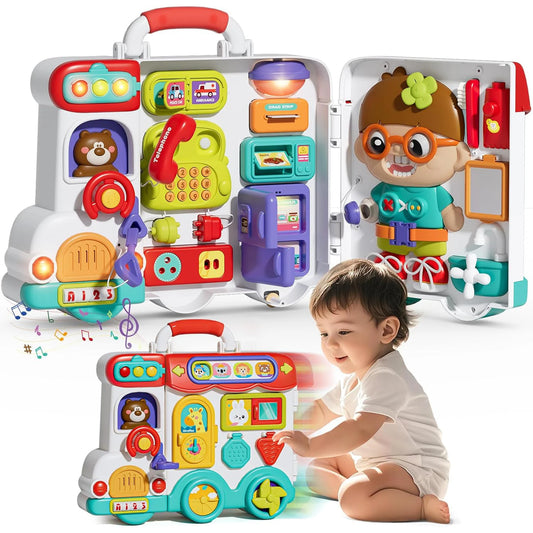

If you are learning how to make a busy board for baby, start with a simple activity panel rather than a hardware-heavy toddler board. A soft panel with large, securely enclosed textures, colours and flaps is generally easier to keep simple for babies who may mouth, suck, pull, shake or drop what they play with. A homemade board should also never be assumed to comply with Australian toy-safety requirements simply because it looks sturdy or has been carefully constructed.
| Planning point | Better approach for babies | Avoid |
|---|---|---|
| Base | Soft or padded activity panel | Heavy, complicated board |
| Activities | Large textures, colours and fabric flaps | Small mechanical parts |
| Moving features | Simple, permanently retained pieces | Loose beads, keys or removable items |
| Power | Passive, non-powered activities | Batteries, lights and wiring |
| Attachments | Fully enclosed and regularly inspected | Exposed screws or small fasteners |
| Use | Supervised awake play | Cot or other sleep spaces |
Should You Make a Busy Board for a Baby?
You can make a simple activity panel for a baby, but one design cannot suit every child from birth to 12 months. A young baby who mainly looks and reaches interacts very differently from an older baby who can sit, pull, shake, crawl towards and lift objects.
This is also why a baby busy board should not simply copy activities designed for one- or two-year-old toddlers. For older children, How to Make a Busy Board for a 1 Year Old: Safety-First Guide and Choosing the Best Toys for 1 Year Old Toddlers offer more age-specific ideas. Homemade construction also does not prove compliance with Australian toy standards or replace product-specific testing.
What Can a Baby Do With a Busy Board?
Depending on their stage, a baby may look at high-contrast shapes, pat different textures, grasp a fabric flap or move a large fixed feature. The purpose does not need to be teaching a specific skill; the panel can simply provide another supervised way to explore colours, surfaces and movement.
Design around what the baby may do unexpectedly as well. Babies commonly explore objects by mouthing, sucking, chewing and pulling. They may also shake or drop the whole panel, so every feature should be considered from the perspective of what happens if it is repeatedly pulled or worn.
Six Baby Busy Board Ideas With Lower-Complexity Activities
The safest baby busy board ideas are usually simple rather than mechanical. A panel does not need locks, switches or dozens of activities to provide variety.
1. Soft Fabric Texture Panel
Concept: Create several large areas with different fabric textures.
Possible features: Smooth cotton, textured fabric and padded shapes can provide tactile variety. This may suit babies who are starting to reach and explore surfaces. Keep every layer securely enclosed and avoid beads, buttons, sequins, exposed stuffing or materials that easily fray.
2. Family Photo Peekaboo Panel
Concept: Place familiar photos behind large fabric flaps.
Possible features: Use one or two enclosed photographs with simple contrasting flaps. This works best as a basic lift-and-look activity rather than a removable photo game. Avoid loose laminated cards, hard frames and thin plastic covers that could crack or detach.
3. High-Contrast Colour Panel
Concept: Create visual interest without mechanical components.
Possible features: Large black-and-white shapes, strong colour contrasts, circles and simple patterns can form the activity. Integrate them into the panel instead of attaching removable cards. Check printed, painted or coated areas regularly for peeling or deterioration.
4. Secure Fabric Flap Board
Concept: Add oversized fabric flaps that reveal another colour, image or texture.
Possible features: Large round or square flaps can provide a simple grasping activity for babies who are beginning to intentionally manipulate objects. Attach each flap securely along a broad edge and avoid adding ribbon handles, elastic loops or cords.
5. Large Fixed Slider Panel
Concept: Include one large feature that moves along a limited path without coming off the board.
Possible features: A broad captive fabric component may offer movement without using a loose bead. This is more appropriate for babies who are intentionally manipulating objects. If the design depends on small screws, washers, beads or detachable end stops, leave the slider out.
6. Simple Mixed Sensory Panel
Concept: Combine two or three simple activities rather than filling the entire panel.
Possible features: One texture section, one flap and one visual area may be enough. Fewer components mean fewer potential failure points and make inspection easier. DIY Busy Board Ideas: A Safety-First Guide for Parents can provide further inspiration, but many toddler activities should be simplified before considering them for babies.
What Should You Not Put on a Baby Busy Board?
Learning how to build a busy board for babies includes knowing what not to add. Many popular toddler-board components introduce hazards that are unnecessary for an infant activity.
| Part or feature | Main concern | Simpler alternative |
|---|---|---|
| Beads, buttons and small shapes | Choking or swallowing | Large integrated fabric sections |
| Small magnets | Serious injury if swallowed | Leave magnets out |
| Button or coin batteries | Severe injury if swallowed | Use passive activities |
| Long cords and ribbons | Entanglement or strangulation | Fixed fabric features |
| Chains and keyrings | Hard parts and possible detachment | Fabric flaps |
| Keys and locks | Small parts and complex hardware | Large tactile areas |
| Glass mirrors | Breakage and cuts | Non-breakable visual feature |
| Brittle plastic | Cracking and sharp edges | Durable materials |
| Loose foam | Pieces may be bitten off | Enclosed textile padding |
| Exposed screws or washers | Detachment or sharp surfaces | Enclosed construction |
Australian Competition and Consumer Commission (ACCC) Product Safety guidance highlights risks involving small parts, magnets, button batteries, cords and damaged toys. These hazards deserve particular attention when designing something a baby may regularly place in their mouth.

Small or Detachable Parts
Small decorative parts can loosen after repeated pulling, chewing or cleaning, even if they appeared secure when first attached. Toys intended for children up to and including 36 months are subject to mandatory Australian requirements addressing small parts and foreseeable wear.
For a homemade panel, reducing the number of detachable components is usually more practical than trying to make many small objects secure.
Magnets and Accessible Batteries
Do not add loose or accessible magnets to a homemade baby busy board. Swallowed magnets can cause serious internal injuries, particularly when more than one is swallowed.
Button and coin batteries can also cause severe injuries if swallowed or inserted. A passive, battery-free panel avoids this problem entirely.
Cords, Chains, Ribbons and Loops
Free-hanging cords, chains, ribbons, elastic and loops can introduce entanglement and strangulation risks. A pulling activity does not need a long cord to function.
Use broad fixed fabric features instead and regularly check whether any material has stretched, torn or changed shape.
Glass, Mirrors and Breakable Plastic
Real glass should not be used as a baby busy-board mirror. Brittle plastics are also unsuitable if they could crack or develop sharp edges.
If you want a reflective activity, consider a purpose-designed baby-safe product rather than adding an improvised household mirror.
Household Locks, Keys and Metal Hardware
Locks, keys, hinges, bolts and chains are common on toddler busy boards but add unnecessary complexity for babies. They may contain small screws, pins, springs or sharp edges.
A baby activity panel can provide plenty to explore through textures, colours and securely attached fabric elements without copying household hardware.
Live Electrical or Battery-Powered Components
Never connect a baby busy board to mains electricity or exposed wiring. Homemade switches, LEDs and sound modules may also require batteries and compartments that introduce additional risks.
Keeping the panel passive removes much of this complexity and makes the finished activity easier to inspect.
Materials for a Homemade Baby Busy Board
For many parents researching how to make an activity board for babies, fabric offers a straightforward starting point. Materials still need to tolerate repeated touching, pulling, cleaning and mouthing without coming apart.
| Material | Possible benefit | Main consideration |
|---|---|---|
| Woven fabric | Soft and versatile | Prevent fraying |
| Felt | Easy to shape | Avoid small removable pieces |
| Padded textile | Softer surface | Keep filling inaccessible |
| Printed fabric | Adds visual interest | Check print durability |
| Timber | Strong rigid base | Weight and hard edges |
| Rigid plastic | Wipeable | Avoid brittle materials |
| Adhesive | Supports some construction | Do not rely on glue alone |
| Paint or finish | Adds colour | Choose suitable products and inspect wear |
Choosing Between a Soft Panel and Rigid Base
A soft panel can provide textures, colours and simple movements without requiring bolts, locks or heavy hardware. It also avoids some of the weight and hard-edge issues associated with timber.
A rigid board may become more useful for older toddlers, but it is not necessary simply because the activity is called a busy board.
Selecting Fabric and Texture Materials
Choose fabrics that remain intact when pulled, rubbed and cleaned. Avoid materials that shed fibres or include sequins, beads and decorative attachments.
Padding can be incorporated into a textile panel, but stuffing should remain completely enclosed. Families interested in wider DIY activities can also read How to Make Montessori Toys, while keeping baby-specific safety requirements in mind.
Photos, Colour Panels and Visual Elements
Photos and high-contrast patterns can add interest without introducing moving mechanisms. Enclose photographs inside the panel instead of giving the baby removable cards.
Regularly inspect printed surfaces and covers for peeling, cracking or rough edges.
Paints, Finishes and Adhesives
Do not assume that every craft glue, paint or finish is suitable simply because it is labelled non-toxic. Follow the manufacturer's intended-use and curing instructions and consider how the finished surface may behave if repeatedly mouthed.
No single adhesive, screw type, timber thickness or construction method can guarantee that a homemade baby toy meets Australian safety requirements.
Backing and Fastener Enclosures
Plan the reverse side at the same time as the front. Stitching ends, fasteners and attachment points should not create hazards on the back of the panel.
If a feature requires exposed nuts, sharp fasteners or a removable cover to keep its fixing hidden, consider simplifying or removing the activity.
How to Plan and Assemble a Baby Activity Panel
A simple seven-step process can help keep the design focused:
- Consider how your baby currently interacts with objects. Think about looking, reaching, grasping, pulling, mouthing and moving.
- Choose the base. Consider a soft activity panel before deciding that timber is necessary.
- Select a few activities. Two or three simple features are usually easier to manage than a crowded board.
- Plan both sides. Decide how every feature will be retained and what will be accessible from the reverse.
- Remove unnecessary hazards. Leave out small parts, magnets, batteries, cords, chains, keys and breakable materials.
- Inspect the finished panel. Check seams, edges, attachments and surfaces before giving it to the baby.
- Use it only during supervised awake play. Reinspect it regularly as both the baby and the panel change.
How to Introduce a Busy Board to a Baby
Place the panel on a stable play surface and allow your baby to explore it during supervised awake time. There is no need to demonstrate every feature or encourage a specific type of interaction.
Watch what the baby actually does with the panel. If they chew an edge, repeatedly pull one feature or try to lift and drop the whole board, reassess that area. Never place a busy board in a cot, bassinet or other sleep environment; ACCC Product Safety guidance recommends keeping toys out of a baby's sleep space.
Baby Busy Board Inspection Checklist
A homemade activity should be inspected throughout its usable life, not just on the day it is completed. Pulling, mouthing, cleaning and normal wear can gradually change its condition.
Check the Panel Before Every Use
Inspect the front, reverse and edges for loose stitching, torn fabric, exposed padding, peeling surfaces, cracks or changes in moving parts.
Pay particular attention to anything the baby regularly pulls or mouths.
Remove It if Anything Changes
Stop using the panel if a component loosens, fabric frays, a covering peels or a rigid part cracks.
Do not wait for a piece to detach completely before treating the change as a problem.
Know When the Baby Has Outgrown the Design
As babies become stronger and more mobile, they may use an activity differently. A panel that was previously patted may later be lifted, bent, thrown or pulled.
Reassess the entire design as the baby's abilities change rather than assuming it will remain suitable throughout the first year.
Homemade or Ready-Made: Which Is Better for a Baby?
A homemade busy board for baby gives you control over photographs, textures and colours, and it can work well when the design is deliberately simple. However, DIY construction does not itself demonstrate compliance with Australian toy-safety standards.
A ready-made baby toy may be more practical if you prefer clearly stated age information and manufacturer documentation. Check product information rather than assuming every item marketed as a sensory toy or busy board is appropriate for babies. Are Montessori Toys Safe for Babies? can also help when assessing products sold with Montessori-style descriptions.
Related Products
Frequently Asked Questions
What Is a Baby Busy Board?
A baby busy board is a supervised activity panel containing simple visual, tactile or movable features. For babies, it can be much simpler than the hardware-filled boards commonly designed for toddlers.
Soft textures, fixed colour areas and large fabric flaps are examples of lower-complexity activities.
What Age Can a Baby Use a Busy Board?
There is no universal starting age for every busy board. Suitability depends on the baby's current abilities and the exact design.
Commercial products should also be checked for their manufacturer's stated age suitability rather than relying on the term “busy board” alone.
Can a Six-Month-Old Use a Busy Board?
Some six-month-old babies may explore a simple activity panel during closely supervised awake play.
For this stage, a soft panel with large fixed visual and tactile features is generally a simpler DIY concept than a wooden board covered with locks or hardware.
What Should Be on a Baby Busy Board?
Keep the design simple. Large texture areas, enclosed pictures, contrasting colours and securely attached fabric flaps can provide enough variety.
Avoid adding activities solely to make the board look busier.
Can You Use Household Items on a Baby Busy Board?
Household items are not automatically suitable for baby toys. Keys, locks, hinges and chains may contain small pieces, hard edges or mechanisms not designed for mouthing.
Purposefully simple materials are usually easier to assess and maintain.
Is a Wooden Busy Board Suitable for a Baby?
A wooden board can be constructed, but timber adds weight, hard edges, finishes and attachment considerations.
For many baby DIY projects, a soft panel is a simpler starting point. Wooden boards may become more relevant as the child moves into toddler activities.
Can You Use Felt for a Baby Activity Board?
Felt can form part of a textile activity if it remains securely attached and does not tear or shed during use.
Avoid small removable felt shapes and regularly inspect edges that the baby pulls or mouths.
Can You Glue Parts to a Baby Busy Board?
Glue should not be treated as proof that a component cannot detach. Adhesive performance varies with materials, application and wear.
If a piece would become hazardous if it came loose, the safer option may be to redesign the activity without that piece.
Can You Put Lights on a Baby Busy Board?
A passive board is generally simpler for DIY baby use. Lights normally introduce electrical parts, batteries and battery compartments.
Because button and coin batteries can cause severe injury if accessed or swallowed, avoiding battery-powered homemade activities reduces unnecessary risk.
Does a Baby Need Supervision With a Busy Board?
Yes. A busy board should be used during supervised awake play.
Supervision also helps you notice when the baby begins using a feature differently or when part of the panel needs to be removed from use.
Is a Homemade Baby Busy Board Cheaper Than Buying a Toy?
It can be cheaper if you already have suitable materials and keep the project simple. Buying fabric, tools, finishes and additional components specifically for one project can reduce the saving.
If cost is an important factor as your child gets older, Best Toddler Toys Under $50 and Best Educational Toys Under $50 can provide alternatives to more complicated DIY projects.
Choose the Safest Activity for Your Baby
Knowing how to make a busy board for baby is mainly about simplifying the activity. Use a small number of securely enclosed visual and tactile features, plan both sides, expect mouthing and pulling, and leave out magnets, batteries, cords, chains, glass and loose pieces. Keep the panel out of sleep spaces and inspect it before use.
If you are not confident that you can construct and maintain a suitable homemade panel, choosing a sturdy, age-appropriate ready-made baby toy with clear product information is a sensible alternative. As your child grows, How to Make a Busy Board for a 1 Year Old: Safety-First Guide provides more appropriate ideas for the next stage..