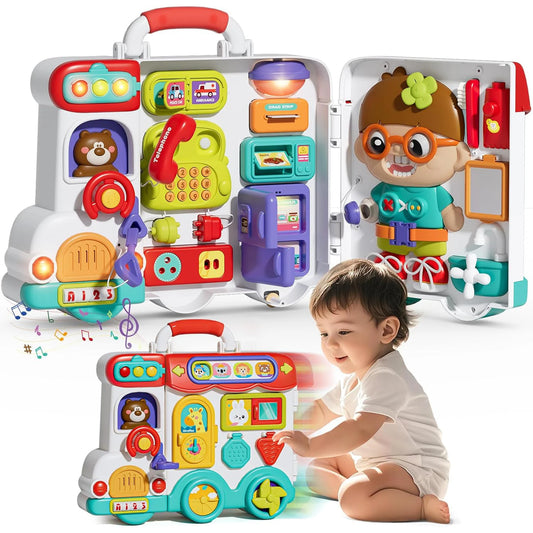
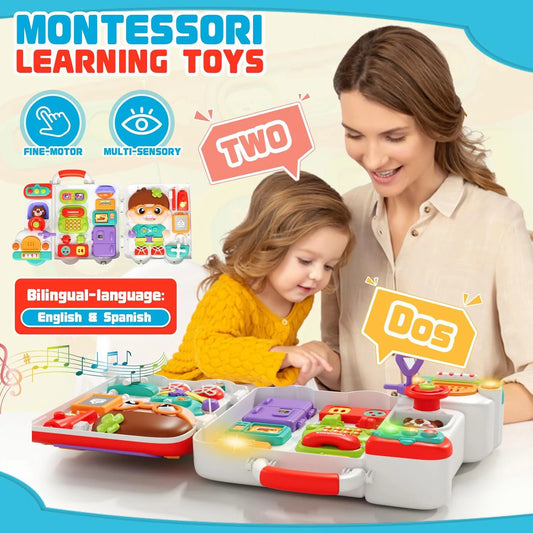
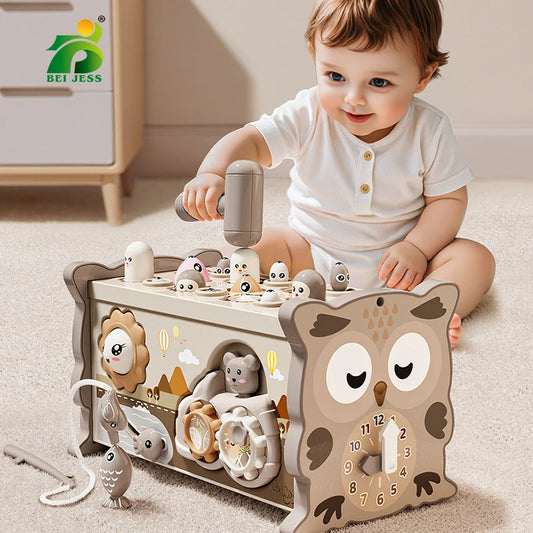
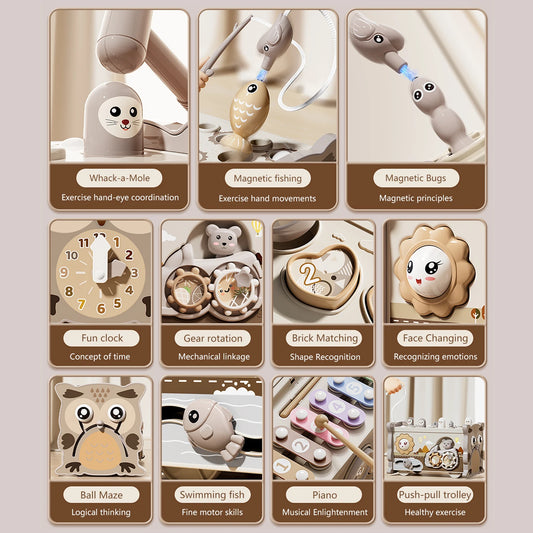

Choosing between the 6 best busy boards for toddlers and babies is less about finding one product that suits every child and more about understanding how different busy board formats match different ages, abilities and play settings. A soft sensory panel designed for an older baby, for example, is very different from a wooden latch board or electronic activity board intended for a confident toddler.
That distinction matters because babies and toddlers should not be treated as one safety or developmental category. Before buying any busy board for babies and toddlers, check the manufacturer's stated age range, warnings, construction and individual components rather than relying on a broad product title. For children up to and including 36 months, Australia has a mandatory toy safety standard designed in part to reduce risks from small parts that can detach or become accessible.
| Busy board type | Often worth considering for* | Main advantage | Main point to check |
|---|---|---|---|
| Soft sensory panel | Babies and younger toddlers | Soft, lightweight activities | Age grading and securely attached pieces |
| Felt busy book | Older babies or toddlers when manufacturer-approved | Portable and easy to store | Loose felt pieces, fasteners and cords |
| Simple wooden latch board | Toddlers | Durable hands-on mechanisms | Hardware, edges and recommended age |
| Activity cube | Toddlers | Several activity surfaces in one toy | Stability, size and detachable components |
| Montessori-inspired skill board | Toddlers | Practical fine-motor activities | Difficulty and authenticity of safety information |
| Electronic or LED board | Usually older toddlers when age-approved | Buttons, switches, lights and cause-and-effect play | Battery security, electronics and age warnings |
*These are broad format observations, not substitutes for the age recommendation and warnings supplied with an individual product.
Can the Same Busy Board Suit Babies and Toddlers?
Sometimes. A manufacturer may design and formally age-grade a particular board across a relatively broad developmental range. However, a product being advertised as suitable for “babies and toddlers” does not prove that it is appropriate for a six-month-old, one-year-old and three-year-old in exactly the same way.
The safer approach is to start with the child's exact age and then confirm the specifications of the individual product. Families shopping primarily for younger children can use Travel Busy Board for Baby: How to Choose Safely for more baby-specific considerations, while Travel Busy Board for Toddlers: How to Choose the Right One focuses on the different demands of toddler travel play.
Why Exact Age Matters
Babies commonly explore objects with their mouths and may pull, chew or twist parts without understanding instructions. As children move through the toddler years, their grip strength, finger control and ability to manipulate zips, buckles, latches and switches generally change considerably. A feature that is frustrating at one stage may become engaging later.
Attention and play style also change. A younger child may focus on texture, movement and simple cause and effect, while an older toddler may be ready to practise fastening, matching, counting or multi-step actions. This is why a busy board age guide should be treated as a starting point for product selection rather than assuming every activity board suits the entire baby-to-preschool period.

Six Busy Board Types Compared
There is no evidence-based reason to declare one busy board format universally superior. Instead, the most appropriate option depends on the child's age, the manufacturer's guidance, how the board will be used and which activities are currently manageable.
The following comparison looks at six common formats rather than presenting an unsupported ranking of six individual products.
-
Soft Sensory Panel
A soft sensory panel usually prioritises fabrics, textures, simple flaps, crinkle sections and other tactile features rather than hard latches or complex mechanisms. This can make the format appealing when parents want something lightweight and relatively gentle for floor play or supervised travel.

For babies, however, “soft” should never automatically be interpreted as “baby-safe”. Inspect whether any buttons, decorations, tabs or other pieces could loosen, and follow the manufacturer's minimum age. Products intended for very young children need to withstand the pulling, chewing and repeated handling typical of this stage.
-
Felt Busy Book
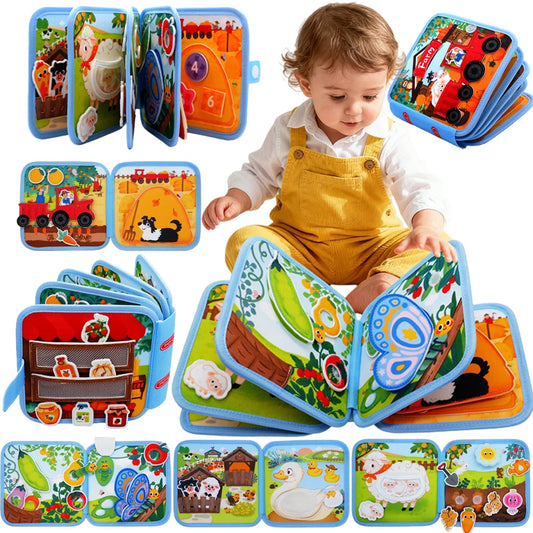
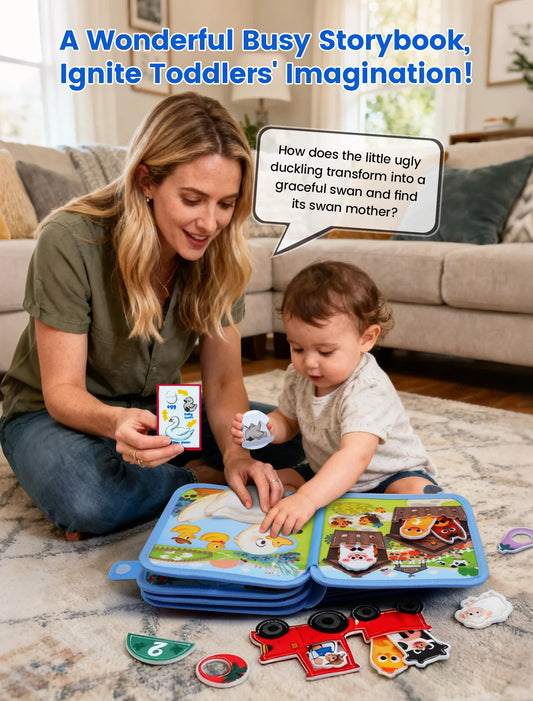
A felt busy board, often made as a folding book, is one of the most portable formats. Depending on the design, pages may include zips, buckles, shoelaces, matching shapes, numbers, colours, clothing fasteners and simple puzzles. When folded, the activities take up relatively little space, which can be useful in a changing bag or during longer trips.
The trade-off is that felt books vary significantly in construction and complexity. Some contain removable shapes or small decorative components, while others have long cords or relatively complicated fasteners. Check the manufacturer's age recommendation and whether all pieces are securely attached before treating a felt book as appropriate for a younger child.
-
Simple Wooden Latch Board
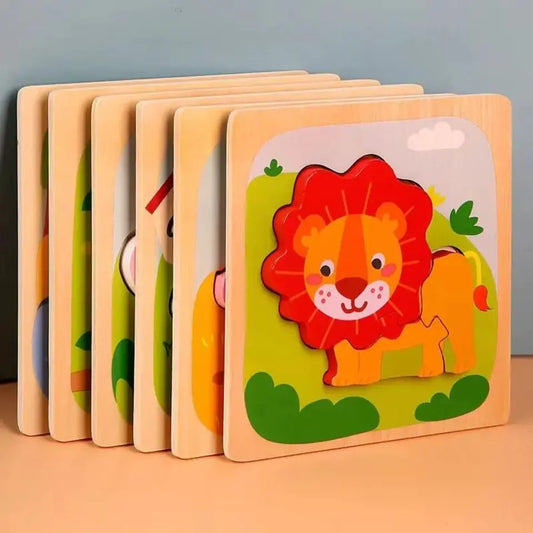
A wooden busy board typically provides a more rigid play surface and may include doors, latches, knobs, wheels, switches or other mechanical features. A simpler version with a limited number of large activities can be easier for a young toddler to understand than a densely packed board with many unrelated mechanisms.

Check more than the appearance of the timber. Look at the stated age, finish, edges, corners, hinges, screws and other hardware, particularly because toddlers can pull forcefully on components. A wooden board may also be heavier than a felt version, so consider where it will be placed and whether the child can move or tip it unexpectedly.
-
Activity Cube
An activity cube uses several sides of a three-dimensional toy to provide different play options. One side might include sliding pieces, another gears or shapes, while the top may have another manipulation activity. The format can offer more play in a relatively compact footprint, particularly for home use.
Its size and stability are important considerations. A child may lean on, push or attempt to lift the cube rather than use it exactly as intended. Before buying, check its dimensions and weight alongside the manufacturer's age information, and inspect whether any activities have removable pieces that require additional attention around younger siblings.
-
Montessori-Inspired Skill Board
A Montessori busy board commonly uses practical-looking activities such as buckles, buttons, laces, zips, clasps and switches. These boards are often marketed around independence or everyday skills, but the word “Montessori” itself does not establish a particular safety level or guarantee that a product follows a specific educational method.
Focus instead on what the child can actually do with the activities. A younger toddler may benefit more from several clear, achievable actions than from a board containing twenty difficult fasteners. As skills develop, a more complex board may provide additional challenge without requiring families to treat a larger activity count as automatically better.
-
Electronic or LED Board
An LED busy board or electronic activity board may contain illuminated buttons, switches, knobs or other controls that produce a visible response. For some older toddlers, this direct cause-and-effect relationship can make switches and controls easy to understand and interesting to repeat.
Battery safety deserves particular attention. Australian requirements apply to products containing button or coin batteries, while battery-operated toys for children up to and including 36 months have specific requirements around securing the battery compartment. Product Safety Australia also advises parents to be cautious with toys that light up, move or make noise because they may contain button batteries.
Related Products
Choose by Baby or Toddler Stage
Age recommendations on a specific product should always take priority over a general guide. Two boards that look nearly identical online can carry different age grading because their components, construction or intended use differ.
Use the following stages to decide what characteristics to investigate, then confirm them against the manufacturer's documentation.
Babies Under 12 Months
For babies, start with products specifically documented for the child's age rather than adapting a toddler board because it appears simple. Large tactile surfaces, easy-to-manipulate features and securely integrated components may make more sense than complicated buckles, miniature latches or removable matching pieces.
Mouthing is particularly relevant at this stage. Toys for children up to and including 36 months are subject to Australian requirements intended to reduce hazards such as accessible small parts. Parents comparing play products for this stage can also see Best Toys for 6 Month Old Babies and Busy Board for Infants.
Toddlers Around One Year
Around the first birthday, children may begin showing more interest in opening, turning, pressing and moving individual components. Simple actions with an obvious result are generally easier to approach than sequences that demand precise finger control.
Look for clear manufacturer age guidance and activities that match the child's current ability rather than buying solely for the number of features. Choosing the Best Toys for 1 Year Old Toddlers provides a broader way to compare busy boards with other toy categories for this stage.
Toddlers Around Two Years
Around two, many children can tackle a broader selection of manipulation activities. Zips, larger buckles, simple latches, wheels, switches and matching tasks may become more practical choices where the individual product is age-appropriate.
This is also a useful stage for considering whether a board provides enough challenge without becoming overcrowded. A board with a manageable set of purposeful activities can be easier to revisit independently than one filled with features that the child cannot yet operate. See Best Toys for 2 Year Old Toddlers for wider age-based toy selection.
Children Around Three Years
Around three, children may be ready for finer fasteners, simple sequences, basic dressing-style tasks and more involved matching or problem-solving activities. This can make larger Montessori-inspired boards, complex felt books and some electronic formats more relevant.
Age three does not remove the need to inspect warnings and construction. Continue checking for loose components, damage and manufacturer instructions, particularly when a younger sibling may also access the toy. The Best Toys for 3 Year Old Children provides additional options beyond busy boards.
How to Decide Which Format Is Best
Once obviously unsuitable age groups have been ruled out, compare products using practical evidence. The best-looking or most feature-packed board may not be the easiest one to use, clean, store or take away from home.
A useful comparison should include the formal age range, activity difficulty, construction, dimensions, weight and care instructions rather than relying only on promotional photographs.
-
Formal Age and Warnings
Start with the minimum and maximum age stated by the manufacturer and read any warnings associated with the product. Do not substitute a marketplace seller's informal description for clearly documented product information.
Australian product safety guidance recommends checking age grading, safety information and instructions when selecting children's toys. For children three and under, particular attention should be paid to components that could become small parts.
-
Useful Activities and Complexity
Count useful activities rather than total activities. Ten features a toddler can understand and manipulate may offer a better fit than thirty miniature mechanisms that are too difficult or simply decorative.
Consider what the child already practises. If they enjoy opening containers, a latch or door may make sense. If they are beginning to manage clothing, larger zips or buckles might be useful. The goal is to find an appropriate level of challenge rather than the largest advertised activity count.
-
Materials, Size, Weight and Cleaning
Material affects more than appearance. Felt boards tend to be lighter and foldable, while wooden boards and cubes can provide a more rigid play surface. Neither format should be considered automatically safer; the individual construction and age grading still matter.
Check product dimensions before ordering, especially when buying online. Also look for cleaning instructions. Some fabric products may permit surface cleaning only, while rigid boards can have components that require careful wiping around hinges, electronics or unfinished areas.
-
Travel and Storage
For travel, portability can outweigh activity count. Folding felt books and lightweight panels often take up less space, while a solid wooden board or activity cube may make more sense as a permanent home toy.
Consider whether loose accessories need to be packed separately and whether the board can be used comfortably in the car, on a plane or at a table. For more detailed travel comparisons, see Travel Busy Board for Baby: How to Choose Safely and Travel Busy Board for Toddlers: How to Choose the Right One.
Safety Checks Across All Six Types
Always check the manufacturer’s age recommendation, warnings and construction before use. Inspect screws, latches, fabric pieces, cords and other attachments regularly, and stop using the board if anything becomes loose or damaged.
For electronic boards, make sure the battery compartment stays securely closed and button or coin batteries cannot be accessed. In homes with children of different ages, also consider whether younger siblings can reach components intended for older toddlers.
- Exact Age Confirm that the manufacturer's documented age range includes the child.
- Small Parts Check whether components can detach or become accessible during use.
- Hardware Inspect screws, hinges, latches, knobs and mechanical fasteners.
- Fabric Attachments Check stitching, felt pieces, tabs, buckles and decorative components.
- Cords and Laces Review their length, accessibility and attachment points.
- Battery Compartment Make sure batteries remain inaccessible and the compartment stays secure.
- Wear and Damage Stop using the board if any part becomes loose, broken or exposed.
- Younger Siblings Consider whether a younger child can access components intended for an older toddler.
Frequently Asked Questions
What Is the Best Busy Board for a Baby?
There is no single best busy board for every baby. Begin with products explicitly age-graded for the baby's exact age and prioritise secure construction, appropriately sized components and activities that do not depend on advanced fastening skills.
A soft sensory format may sometimes be worth considering, but only when the manufacturer's information confirms that the individual product is suitable. A product being soft or fabric-based is not enough evidence by itself.
What Is the Best Busy Board for a Toddler?
The best fit depends on the toddler's age and current abilities. Younger toddlers may prefer straightforward turning, pressing and opening activities, while older toddlers may be ready for latches, buckles, zips, matching tasks and simple sequences.
Compare the best busy boards for toddlers and babies by age evidence and practical features instead of assuming the board with the most activities offers the greatest value.
What Age Are Felt and Wooden Boards For?
There is no universal age for either material. A felt busy board can contain removable or complex components, while a wooden busy board can range from a simple toddler toy to a board containing hardware intended for older children.
Always use the age grading and warnings for the specific product. Material describes how a board is made; it does not establish who can safely use it.
Are Montessori Busy Boards Really Montessori?
“Montessori busy board” is commonly used as a product description for boards featuring practical manipulation activities, but the label alone should not determine your purchase.
Look at the actual activities, level of complexity, manufacturer's age range and construction. A simpler skill board that suits the child's abilities can be a more appropriate choice than a heavily marketed product containing many unnecessary features.