




Face Change Rubiks Cube
- Regular price
- $16.99
- Regular price
-
- Sale price
- $16.99
- Unit price
- per
Shipping in 2-4 days
Sku : NO0018
Couldn't load pickup availability
Quick details
| Product type | Expression-card and wooden block matching game |
|---|---|
| SKU | NO0018 |
| Recommended age | 36 months and above |
| Players | Solo practice or up to four players |
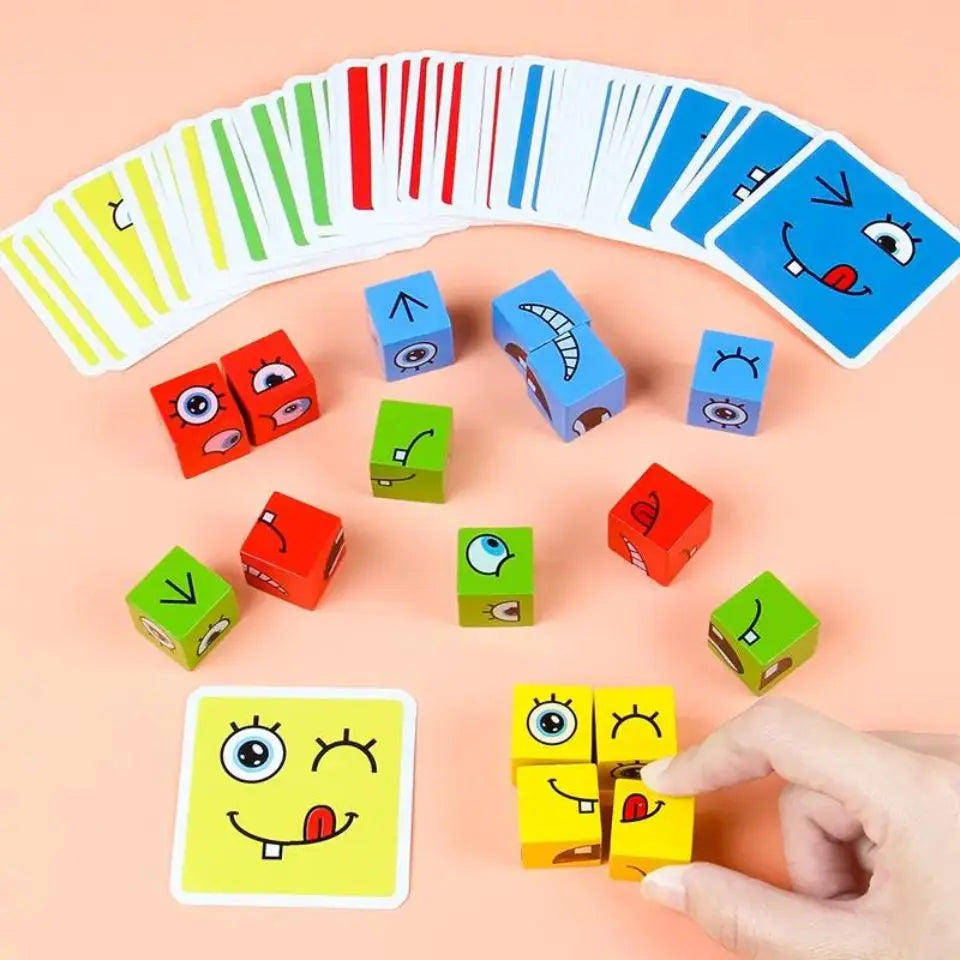
| Playing pieces | 16 wooden expression blocks (4 sets of 4) in red, yellow, green and blue, plus a deck of expression challenge cards |
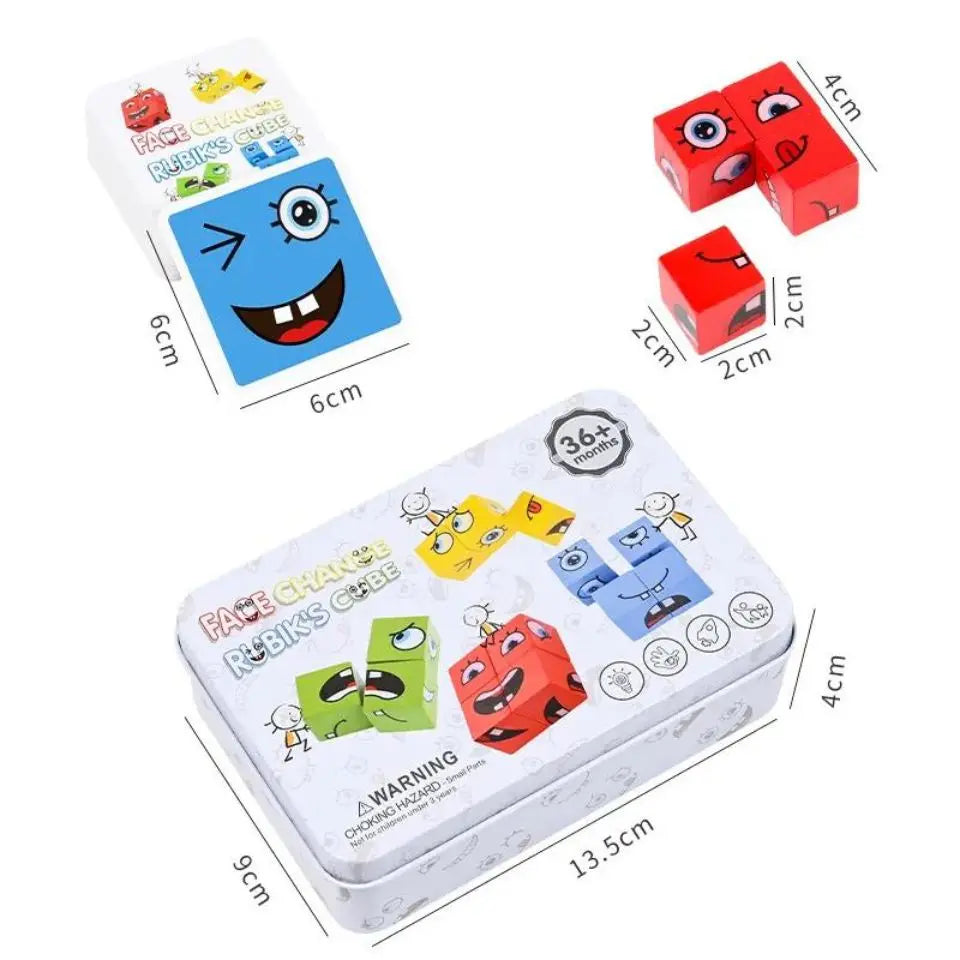
| Storage | Illustrated metal storage tin |
| Tin size | Approximately 13.5 × 9 × 4 cm |
| Card size | Approximately 6 × 6 cm |
| Assembled face height | Approximately 4 cm, built from four 2 cm block sections |
| Operation | Manual and battery-free |
| Shipping | 2–4 days |
A fast face-changing cube game without a screen
Face Change Rubik's Cube is a hands-on matching game where children arrange four printed blocks to copy the expression shown on a challenge card. The blocks show eyes, mouths and other facial details that combine into happy, surprised, silly and puzzled-looking characters.
Despite the familiar product name, this is not a conventional twistable Rubik’s Cube. Players rearrange four separate blocks to build a square face. That simple distinction helps shoppers looking for a face-change Rubik’s Cube game understand exactly how it works.
It's part of our wooden toys collection — browse more screen-free, battery-free wooden games and puzzles alongside it.
Face Change game instructions
- Set up the cards. Shuffle the expression challenge cards and place them face down where every player can reach.
- Choose a colour. Each player takes the four matching red, yellow, green or blue expression blocks.
- Reveal one card. Turn the top challenge card face up so the whole expression is visible.
- Build the face. Rotate and reposition the four separate blocks until the eyes and mouth match the card.
- Check the result. Compare every facial section, not only the colour or mouth.
- Score the round. In competitive play, award the card or one point to the first accurate match. Agree on the number of rounds before starting.
Four ways to use the face-changing cube game
Copy the card
Choose one challenge card and recreate the expression with four blocks. Start with the card beside the blocks rather than holding it up.
Timed challenge
Once everyone understands the matching method, add a gentle timer or race. Skip the timer if it causes frustration.
Memory match
Look at a card briefly, turn it face down and rebuild the expression from memory. Reveal it again to check.
Expression story
After completing a face, invent a short reason the character might look that way. There is no single correct story. For more information, check How to Play the Face Change Rubik's Cube
Using the expressions as conversation prompts
The printed faces can open simple conversations about what children notice. Rather than telling a child what every character feels, ask open questions:
- “What do you notice about the eyes and mouth?”
- “Does this face look happy, worried, surprised or something else to you?”
- “What might have happened just before this picture?”
- “Can the same expression mean different things in different situations?”
The game can support observation and emotion vocabulary through conversation, but it does not assess emotional intelligence and does not guarantee a developmental outcome.
Solo, cooperative and competitive play
| Play style | Setup | Good to know |
|---|---|---|
| Solo practice | One colour set and one card at a time | Useful for learning how block orientation changes the face. |
| Adult and child | Build together or take turns choosing blocks | The adult can model checking the card without completing it for the child. |
| Cooperative group | Players build one expression together | A calmer option when racing would be distracting. |
| Up to four-player race | One four-block colour set per player | Agree on accuracy, scoring and how ties are handled before starting. |
Product image buying guide


Parent and educator tips
- Show one completed match before expecting a child to understand the block arrangement.
- Begin without speed rules and introduce racing only after the matching method is familiar.
- Turn the card so every player sees it from the same direction.
- Use descriptive prompts about eyes, mouths, colours and positions rather than giving the answer.
- Let children disagree respectfully about the emotion a face suggests; expressions can be interpreted in different ways.
- Pause if a child becomes frustrated and switch to cooperative or storytelling play.
Travel, pack-up and storage
Use a stable surface
The blocks need a flat table or supported tray. They are not connected, so they can slide on an angled lap.
Count before leaving
Check all four colour sets and the card deck before closing the storage tin, especially after travel or classroom use.
Keep clear of restraints
During vehicle travel, do not let the tin or loose blocks interfere with a child restraint. An adult should manage pieces that fall.
Keep the tin dry
Store the cards and blocks only when dry and keep the closed tin away from damp areas and direct heat.
Care instructions
- Wipe blocks gently with a dry or slightly damp soft cloth.
- Do not soak the wooden pieces or printed challenge cards.
- Dry every component completely before returning it to the metal tin.
- Keep cards flat and avoid bending their corners during quick rounds.
- Stop using any block with a crack, splinter, lifting print or loose surface.
- Follow any additional care or safety instructions supplied with the delivered set.
Safety and first-use checks
Age marking: 36 months and above. Adult supervision is recommended, particularly during first use, group play and travel.
Before play, inspect the blocks for cracks, splinters, sharp edges or lifting printed surfaces. Check the cards and tin for damaged or sharp edges. Keep every loose block away from children under three and from anyone who still mouths toys.
Regular play builds visual comparison, concentration and hand-eye coordination — it's a fun way to practise these skills, not a therapy tool or a guaranteed memory or emotional-intelligence boost.
Frequently asked questions
How do you play Face Change Rubik’s Cube?
Reveal an expression card and arrange four matching coloured blocks to copy its eyes and mouth. For competitive play, the first accurate match wins the round.
Is this a twistable Rubik’s Cube?
No. It uses four separate expression blocks. Players rotate and rearrange the blocks on a table rather than twisting connected rows of cubes. Browse more logic and matching games in our puzzle collection.
What age is the game for?
Ages 36 months and above. Adult supervision is recommended, especially during first use and group play, since the set includes small parts.
How many children can play?
It can be used for solo matching, adult-and-child play, cooperative play or a race with up to four players using the four coloured block sets.
What comes with the game?
16 wooden expression blocks in four colours — 4 each of red, yellow, green and blue — plus a deck of expression challenge cards and an illustrated metal storage tin.
How many challenge cards are included?
The set comes with a full deck of expression challenge cards covering a wide mix of faces, so rounds stay varied for solo and group play. We're confirming the exact card count with our supplier and will update this once it's locked in — if you'd like the number now, contact us at info@toys4us.au.
Can children play without racing?
Yes. Children can copy cards at their own pace, build cooperatively, try a memory match or make stories about the expressions.
Is it a magnetic face puzzle?
No. This page is for the wooden expression-block matching game. The separate Magnetic Face Change Mosaic uses movable magnetic pieces instead.
What skills can children practise?
Visual comparison, concentration, block orientation, turn-taking and hand-eye coordination — the kind of skills that build up naturally through repeated rounds.
Is it suitable for travel?
The storage tin makes pack-up convenient, but the loose blocks need a stable surface and adult supervision. Count every component before leaving.
How should the pieces be cleaned?
Use a dry or slightly damp soft cloth, do not soak the wooden blocks or cards and dry everything completely before storage.
What should I consider when choosing a puzzle cube for a young child?
For children under 5, look for chunky pieces that don't rely on a twisting mechanism, an age marking that matches your child, and screen-free, battery-free play if that matters to your family — this set is built around all three. See the full How to Play the Face Change Rubik's Cube guide for a step-by-step walkthrough.
Ready for the next face change challenge?
Choose a card, arrange four blocks and see who can spot every detail. The Face Change Rubik's Cube game is available from Toys4us with the current page showing shipping in 2–4 days.
Shipping in 2-4 days