


5 in1 logarithmic board
- Regular price
- $26.99
- Regular price
-
- Sale price
- $26.99
- Unit price
- per
Shipping in 2-4 days
Sku : NO0019
Couldn't load pickup availability
Quick details
| SKU | NO0019 |
|---|---|
| Recommended age | 36 months and above |
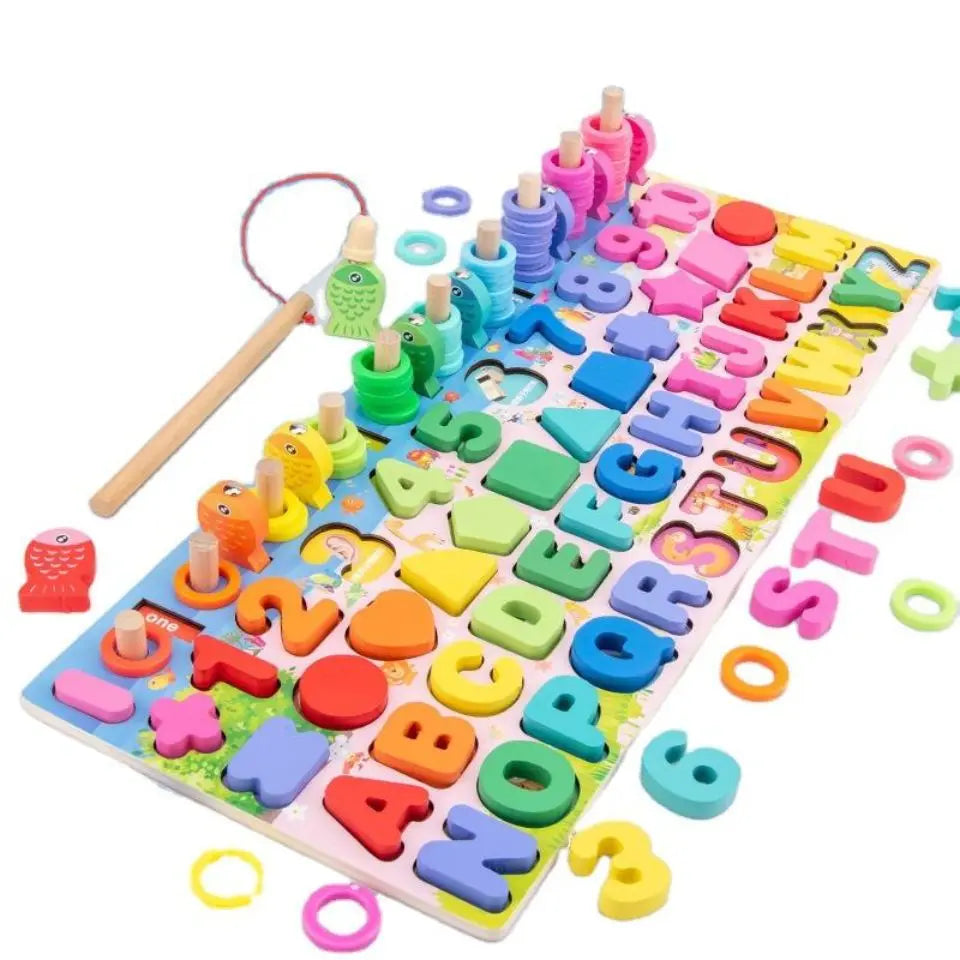
| Five activity areas | Alphabet matching, number matching, geometric shapes, counting-ring stacks and fishing play |
| Letters shown | A–Z alphabet pieces |
| Numbers shown | Number pieces from 1 to 10, with illustrated counting spaces |
| Other pieces shown | Coloured rings, stacking pegs, geometric shapes, fish pieces and a fishing rod |
| Operation | Manual and battery-free |
| Board size | Not confirmed on the current product page |
| Current option | One standard set; no colour or size variants currently shown |
Five matching, counting and fishing activities on one board
The 5-in-1 Wooden Alphabet, Number & Fishing Board combines colourful alphabet pieces, numbers, geometric shapes, stacking rings and a fishing activity in one hands-on set for children aged three years and above.
Children can begin with simple piece-to-slot matching, then use the same board for letter naming, number order, colour sorting, counting and pretend fishing. The play is manual and battery-free, making it suitable for supervised home, preschool and quiet learning activities.
The five activities explained
1. Alphabet matching
Place the coloured A–Z pieces into the corresponding illustrated letter spaces. Begin with a few familiar letters rather than emptying the whole alphabet onto the table.
2. Number matching
Match the number pieces from 1 to 10 with their spaces and practise placing them in order from smallest to largest.
3. Shape matching
Compare each geometric shape with the matching recess. Children can also group the loose pieces by colour or by straight and curved edges.
4. Ring counting
Stack coloured rings on the upright pegs. Use small amounts first and count each ring aloud as it is added or removed.
5. Fishing game
Use the pictured rod to lift the fish pieces, then return each fish to its position. Keep the cord controlled and the board flat during play.
First-time setup
- Check the complete set. Lay out the board, alphabet, numbers, shapes, rings, pegs, fish and fishing rod.
- Inspect every component. Look for cracks, splinters, sharp edges, loose magnets, lifting paint or a damaged cord.
- Place the board flat. Use a clear table or floor space where loose pieces will not roll under furniture.
- Start with one section. Leave the unused alphabet, number and shape pieces in a container so the activity remains manageable.
- Demonstrate once. Show how one piece fits or how the rod lifts one fish, then allow the child to try.
- Count before pack-up. Return the letters, numbers, shapes, rings and fish to their places before storing the set.
Ways to adjust the activity
| Play idea | How to set it up | Keep it manageable |
|---|---|---|
| First matching game | Offer three clearly different pieces beside their spaces | Add more only after the child understands the matching action. |
| Colour search | Ask the child to find one named colour among the loose pieces | Accept colour descriptions used at home and avoid turning it into a test. |
| Number line | Place numbers 1–5 in order, then progress to 1–10 | Use the printed spaces as a visual check. |
| Fishing turn-taking | Each player lifts one fish and returns it before the next turn | Keep the rod cord away from faces and necks. |
| Memory challenge | Show two or three pieces, cover them and remove one | Let the child look again if recall becomes frustrating. |
Using the board for counting and early maths
Count one object at a time
Touch or move one ring while saying each number. This helps keep the spoken count connected to a physical object.
Compare small groups
Build two short ring stacks and ask which has more, fewer or the same number of rings.
Match symbol and quantity
Pair a number piece with the same number of rings or fish. Begin with small quantities before using the full range.
Make simple stories
Try prompts such as “Three fish are on the board and one is caught.” Let the child move the pieces to work out what remains.
Alphabet and language play
- Find the first letter in the child’s name or another familiar word.
- Match uppercase letter pieces to the printed alphabet spaces.
- Name an animal or object pictured near a letter without claiming a fixed phonics programme.
- Group a small selection of letters by colour before returning them to alphabetical order.
- Invite the child to trace the edge of a large letter with a finger while naming it.
The pieces invite letter recognition and naming through play, but they do not guarantee reading progress or replace structured literacy teaching.
Product image buying guide


Managing the loose pieces
- Use shallow trays or containers to separate letters, numbers, shapes, rings and fish during play.
- Count the main groups before and after home, preschool or travel use.
- Keep all small pieces away from children under three and children who still mouth toys.
- Do not add replacement magnets, metal parts, cords or homemade fishing rods.
- Remove any piece with a crack, splinter, loose magnet or lifting surface.
- Store the fishing rod separately from loose pieces so its cord does not tangle around pegs.
Care and storage
- Wipe the board and pieces with a dry or slightly damp soft cloth.
- Do not soak wooden pieces, magnets, printed surfaces or the fishing-rod cord.
- Dry every component fully before placing it in a box or closed container.
- Store the board flat where upright pegs will not be crushed by heavier toys.
- Keep pieces away from direct heat, prolonged sunlight and damp storage areas.
- Follow any additional care instructions supplied with the delivered product.
Safety and supervision
Recommended age: 36 months and above. This set contains many loose pieces and a fishing rod with a cord, so adult supervision is recommended.
Inspect the board, upright pegs, letters, numbers, rings, fish, rod, cord and magnetic components before every use. Stop use if a piece cracks, a magnet loosens, a cord frays, paint lifts or a sharp edge develops.
Keep the fishing cord away from the neck and face. Never place the rod, cord or loose pieces in a cot or sleep space. Store the complete set out of reach of younger children.
The board offers opportunities to practise matching, counting and hand movements. It does not guarantee improvements in memory, intelligence, academic performance or sensory development.
Frequently asked questions
What are the five activities?
The images show alphabet matching, number matching, shape matching, coloured ring stacking/counting and fishing play.
Does the board teach logarithms?
No. It is an early-learning matching and counting board. The existing “logarithmic” wording does not refer to advanced logarithmic mathematics.
What age is it suitable for?
The current product information recommends 36 months and above. Supervise play and keep the loose pieces away from younger children.
Is the fishing activity magnetic?
The images show a fishing rod lifting fish pieces through small contact points. Inspect the fishing components before use and stop if any magnet or metal insert becomes loose.
Which letters and numbers are shown?
The product images show uppercase A–Z letter pieces and number pieces from 1 to 10.
Are the exact dimensions confirmed?
No dimensions are supplied on the current Toys4us page. Avoid relying on measurements from similar-looking products sold elsewhere.
Can every piece be used for fishing?
No. Use the fishing rod only with the fish pieces designed for it. Letters, numbers, shapes and rings should be moved by hand.
Can it be used for independent play?
Children can make their own matching choices, but adult supervision remains important because the set includes many loose pieces and a corded rod.
How should the board be cleaned?
Wipe it gently with a dry or slightly damp cloth. Do not soak the wooden pieces, cord, printed surfaces or magnetic parts.
What should I check when it arrives?
Check the board, pegs, A–Z letters, numbers 1–10, shapes, rings, fish and fishing rod. Set aside the toy if anything is damaged, sharp or loose.
Match, count, stack and fish
Choose one activity, place the board on a flat surface and let children explore the colourful pieces with adult supervision. Before buying, note that the exact board dimensions and a storage container are not confirmed.
Shipping in 2-4 days